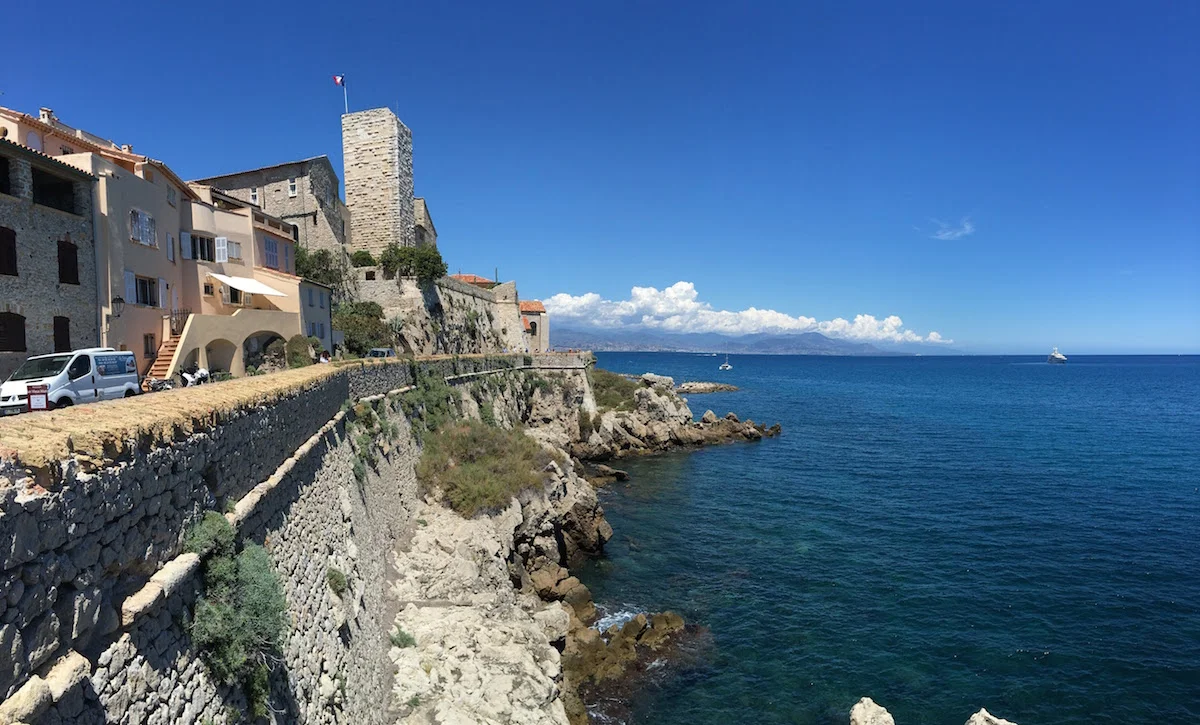
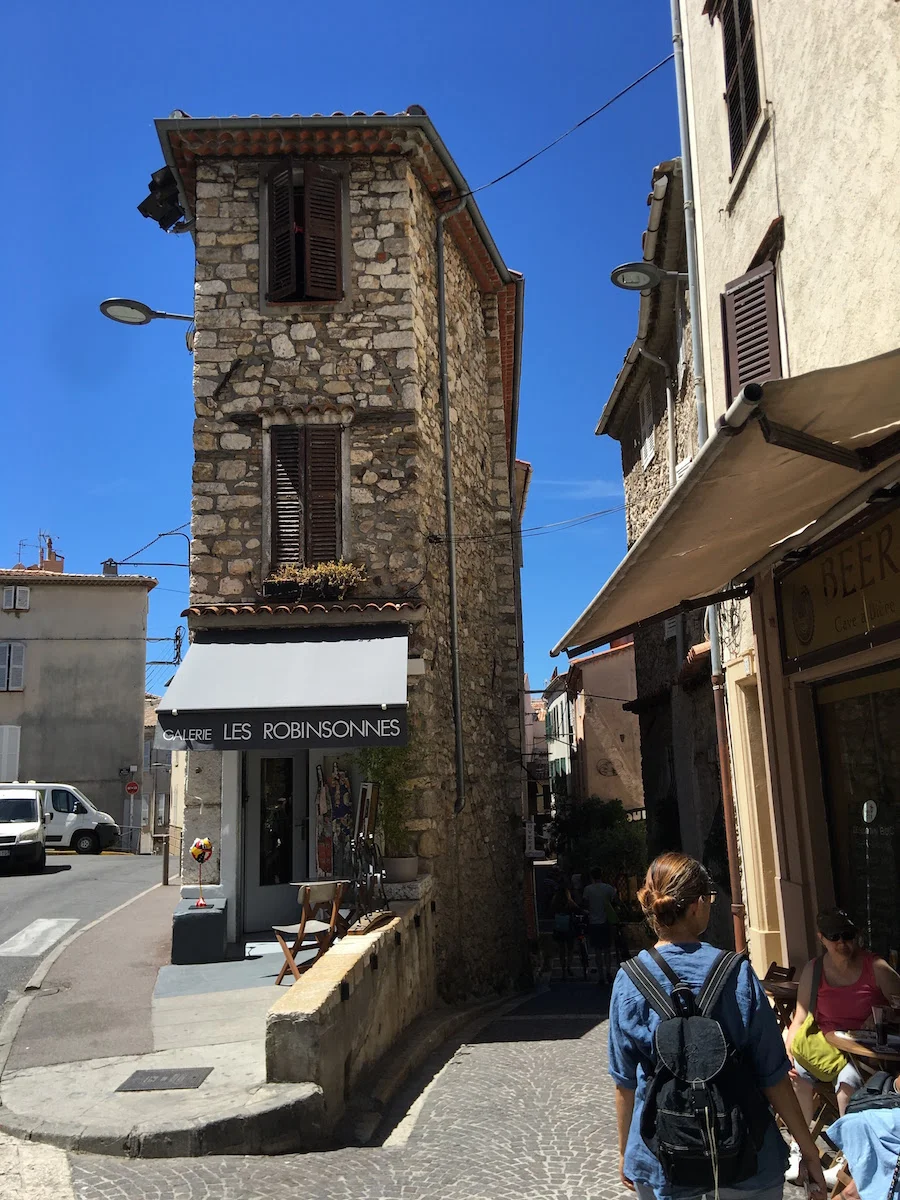
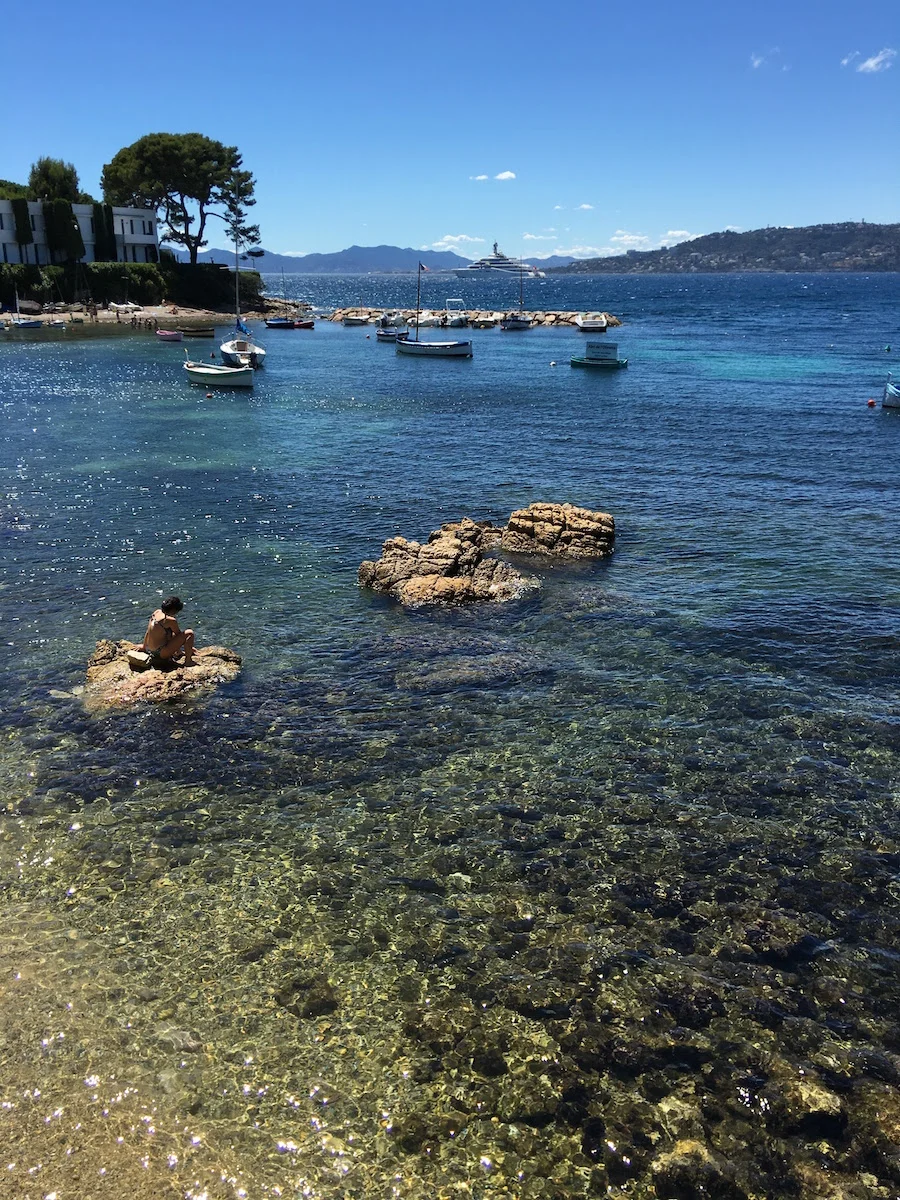
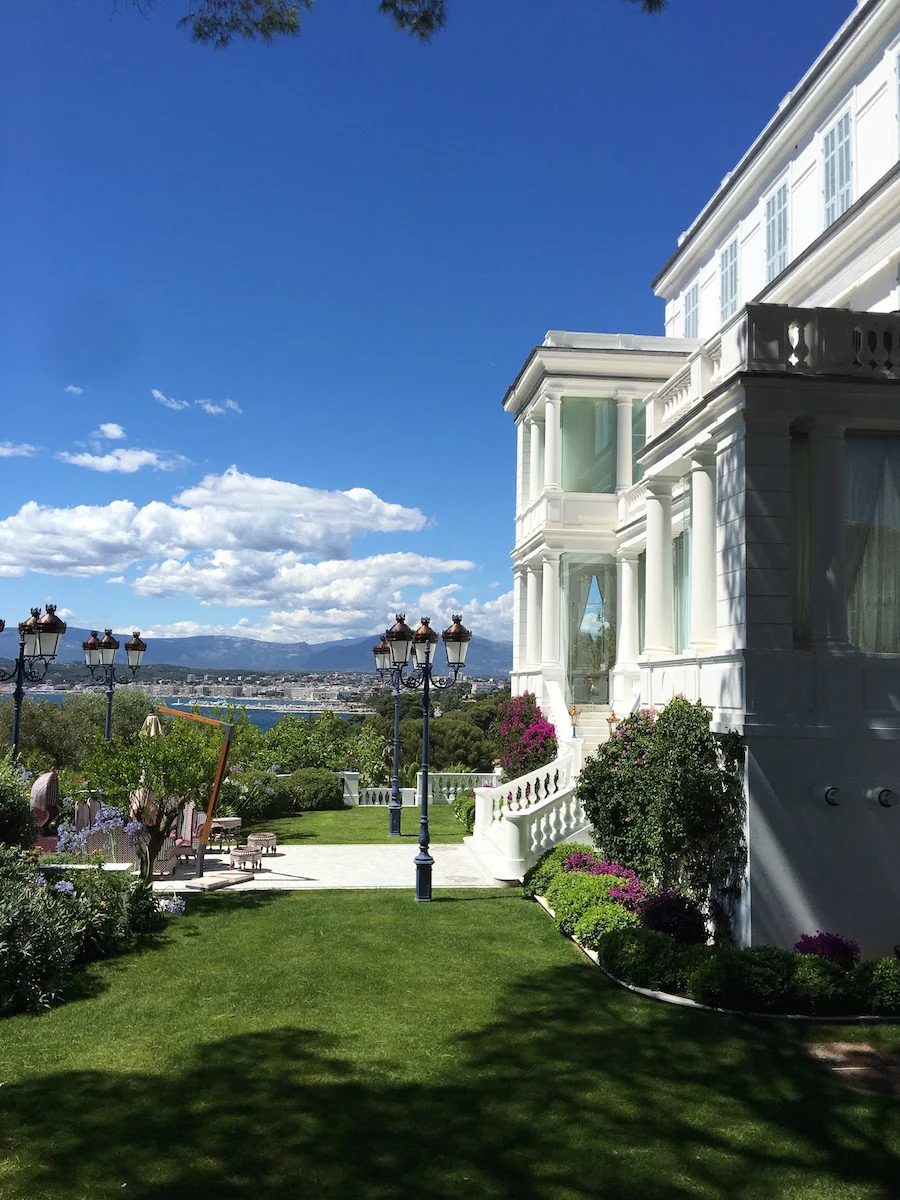
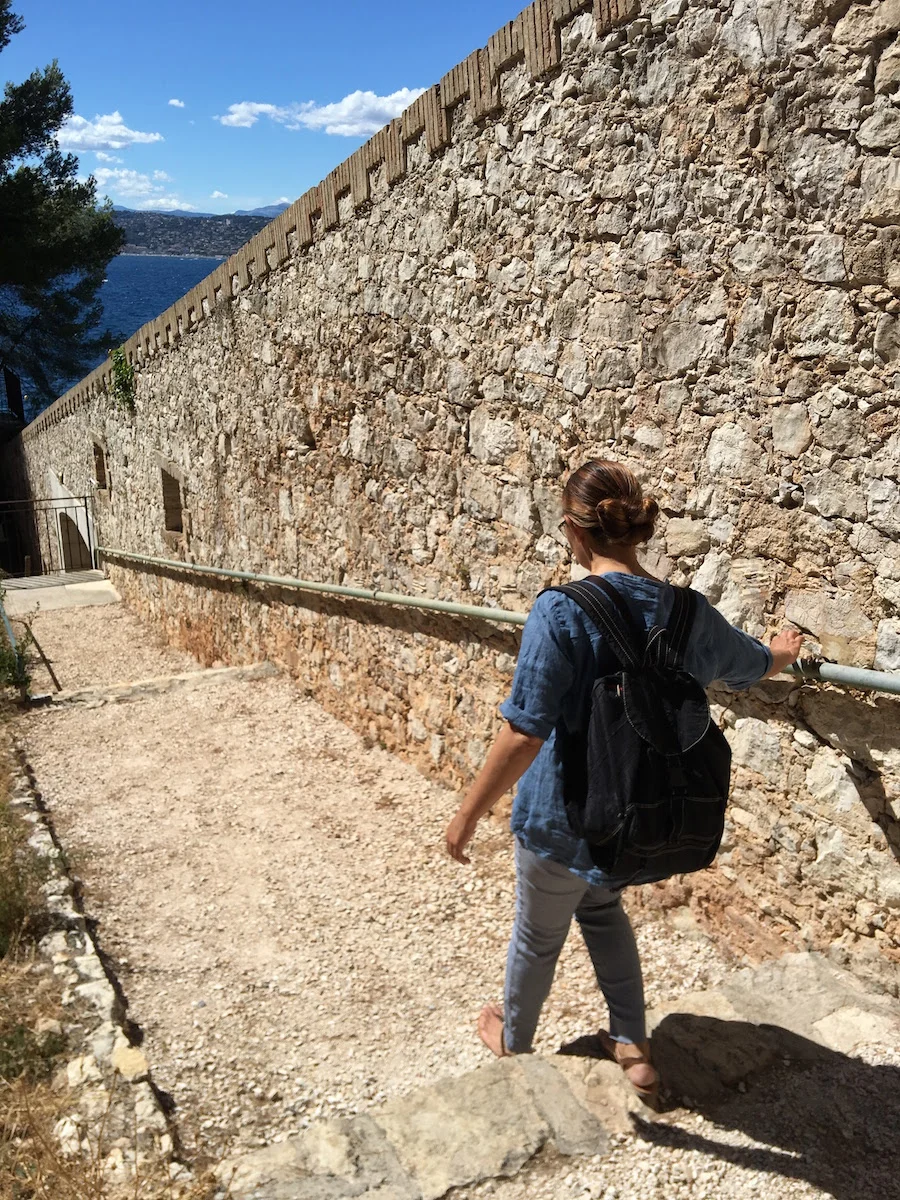
We took a bus Saturday morning from Cannes, where we're staying, to nearby Antibes — probably 7 or 8 miles from our apartment.
Then we walked.
We walked up and down and around the incredible outdoor food market there. (Amira bought spices and brownies.)
We walked all over the town.
We walked down and around an ancient nearby sea-front fortress, down the full length of the nearby peninsula, and all along the shore. (I jumped in the water and swam across a tiny bay. It was cold, but beautiful.)
From there, we walked along the shore all the way back to Cannes, stopping to check things out, eat pizza, drink beer, take pictures and watched a glorious sunset. From the elevated sidewalk next to the shore, we saw restaurants and weddings and picnics and fishermen. Everybody was drinking rosé. Everybody. Most in chilled glasses at restaurants or on picnic blankets. We saw at least 5 young guys drinking rosé from the bottle while walking around on the sidewalk.
One group combined fishing with picnicking. We were on an elevated part of the sidewalk there, and were looking down at what a great time they were having. One guy saw us, and waved us down to join them. It was late already, so we declined, but regretted it.
By the time we got back to Cannes, it was midnight. We walked around 15 miles.
The people who are driving and the people who are walking live in different worlds. Walking lets you see everything up close, and lets you stop and check things out. You really get to know the places you go when you walk.
Walking also seems to be good for your thought process. We always come up with great ideas while walking. And it's only when I walk these days when I get to catch up on my podcasts.
Whenever we move to a new city, we get to know it by walking on every street, over and over. You really get to know a place, what its rhythms are and how it all works.
Walking is fun. It's great exercise. It's good for the environment. And it's easy.
My favorite part, though, is that you get to see everything up close and personal. And discover the world, one step at a time.
Why you want to run away
Admit it: You just want to run away sometimes.
That “run away” feeling is just a normal, temporary impulse — a reaction to the frustrations and banality of everyday life.
It passes, though. Soon enough, you come to your senses and remember all the reasons why you can’t run away.
But here’s a thought: What if that impulse is right? What if you actually should follow your instinct to run away? And what if all the reasons you think you can’t are wrong?
It’s ironic, really. Running away from it all would make you happy. But you can’t run away because of all the responsibilities and obligations, which you chose… in order to be happy.
In pursuit of happiness, you got an education. Then a job. Then another job. You moved to a town where there are lots of jobs. You rented an apartment or bought a condo or house. And you bought a car. And started a family. You got into levels of debt that would have shocked your grandparents. You delayed gratification a thousand times. You scrimped and saved and sacrificed. You endured study and confinement. You put others first and postponed or canceled your dreams. And you did it all in the service of happiness.
So why do you feel the impulse to run away?
The short answer: You’re bored.
The longer answer: You’re an intelligent, curious, adventurous person who’s been dragooned into servitude by the circumstances of time and place. You’re a cog in the wheels of the industrial economy. The world doesn’t care if you’re happy and free. It demands only that you produce and spend.
You’re supposed to own a house. So maybe you own a house. But it feels like the house owns you. So many repairs. So much maintenance. So much cleaning, mowing and decorating. So much money for the mortgage and taxes. Your life feels like an endless grind of dishes, errands and workplace drama. It’s the opposite of what makes you feel joy and happiness.
Deep down, you’re an explorer, a wanderer and — if we’re being honest — a bon vivant.
Facebook tells you that others are having fun. Other people’s lives seem to overflow with adventure, ease and joy. (It’s all a social media “success theater” illusion, but still… Why can’t your days be filled with such things?)
Wasn’t life supposed to be different?
How would you explain to your 19-year-old self what your life has become?
You have mastered the art of delaying gratification. Someday you’ll walk the Camino de Santiago. And the Appalachian Trial. Oh, and the Pacific Crest Trail. (That’s a full year right there, at least! Sigh…)
Someday you’ll experience the Egyptian pyramids. And the Mayan pyramids. And the Taj Mahal, the Forbidden City, Angkor Wat, Machu Picchu, and Petra. And the Great Wall of China, for God’s sake. Are you really going to die without standing on the Great Wall of China?
Someday you’ll experience the mossy quiet of ancient Buddhist temples in Kyoto, witness the burning animal violence of the Australian Outback and bob like a cork in the Dead Sea.
Someday.
Or will you? When does “someday” happen, exactly? Vacation? Retirement?
How about September? Click here to sign up for our Barcelona Experience 2017!
One Spot Left for The Barcelona Experience!
Our plans for the Barcelona Experience are close to being finalized!
But here's the urgent news: We're down to one remaining spot for a single couple.
(Grab it now: https://goo.gl/ST6l9b )
Our small group is going to live for five nights and six days (September 12-17) in a big, comfortable luxury apartment in the heart of Barcelona.
Amira and I and our staff will lead the most amazing romp through Catalonian culinary culture ever assembled.
Using the apartment as headquarters, we'll gather for sessions, tastings, workshops and parties.
Plus, we'll take outings and excursions to places around town and to the nearby Cava country.
Here's a partial list of the incredible foodie stuff we're going to enjoy:
* Traditional bread baking class with Spain's #1 baker
* Day in the Cava country tasting biodynamic bubbles with the top natural winemakers
* Grape harvesting in Penedes vineyards and winemaking the Catalonian way
* Local artisanal cheese class with expert affineur to the Michelin restaurant chefs
* Wood-fire cook-out of Catalonian delicacies
* Quality time in exclusive studio with a famous Catalonian ceramacist and artist
* Guided walk around La Boqueria Market to shop the way the locals do
* Market to kitchen to table Paella and Sangria master class taught by Catalonia’s most talented couple (who are the leaders of Barcelona’s organic food movement)
* Authentic Paella and Sangria Party!
* Perfect Mediterranean picnic and beach day
* Spanish Vermut (vermouth) class and tasting
* Tapas hopping (a.k.a. restaurant roulette) at the city's best tapa joints
* Decadent and bohemian day and night in the Gothic Quarter
* A lavish Catalan gastronomy dining experience under the stars
* Journey through Spain's best wines with Spanish cheese pairing
* Traditional market-restaurant seafood culinary experience
* Intimate and exclusive Flamenco entertainment
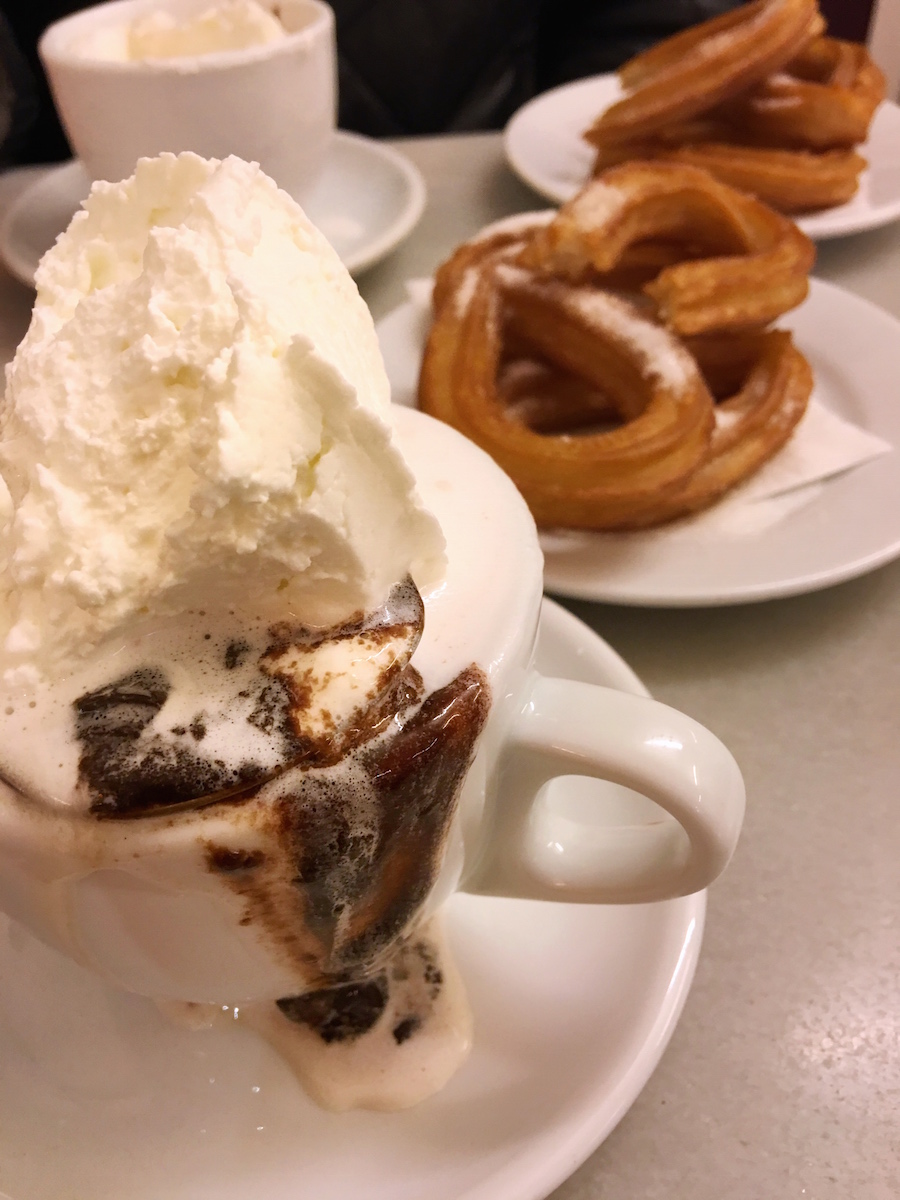
* Old-fashioned Spanish hot chocolate and churro respite
* And other secret surprises!
This guy tried to con me out of $18
Marrakesh is a one-of-a-kind and ancient Moroccan city that I love. But in recent years, it has grown a problem of overly aggressive tourist exploitation.
This comes in the form of "guides," shop-keepers and street vendors who mercilessly badger and harass you into paying for their services. It also comes in the form of phony food operations. For example, Berber tagine cooking is one of the world's greatest culinary innovations. The magic is in not only ingredients and seasoning, but also in the cooking of meat and vegetables together inside an earthen "oven" of exactly the right shape over an open fire. But many restaurants in Marrakesh simply cook stuff and throw it into a tagine at the last minute, figuring that tourists don't know the difference.
This guy is yet another example. Because the Marrakesh medina can't handle cars and trucks, porters work the peripheries with carts. For a little over $2, they'll roll your luggage in a wheeled cart from the edge of the medina to your hotel.
The standard rate is 15 dirhams, or 20 dirhams at the highest price (20 dirhams is around $2.05.) It's a good deal for visitors. And it's a good living for the porters, who can earn over $20 per hour in a country where the minimum wage is $1.50 an hour.
All the porters routinely charge 15 to 20 dirhams for their service and have done for years.
Still, Amira and I like to carry our own bags, and tend not to use such porters. But our driver figured that it would be easier for us to follow a porter, who knew where our riad was, than to convey directions through the maze-like medina. Our driver asked the porter "how much?," and he responded "twenty."
So we got to the riad, and handed him 20 dirhams, and he said, "what's this?" We said it was his 20 dirhams. And he said, "dirhams? no dollars!" He was pretending there was a mixup and that he told us his fee was $20 US dollars for five minutes of unskilled labor.
You'll note that $20 is more than we've paid for a night in a beautiful riad. It's a lot of money in Morocco.
So the porter got aggressive and hostile, which I assume would inspire many visitors to just pay him $20 to go away. But we've been around the block a few times and aren't easily intimidated by street husltlers. So Amira pushed $40 dirhams into his hands. I told him his con earned him double the agreed-upon fee and that he would have to be satisfied with that. Then I took his picture and shut the door in his face.
Welcome to Marrakesh.
Putting the 'Bar' in Barcelona
I'm not a big bar guy, and generally don't drink distilled beverages (I do enjoy great fermented libations like very good beer and very good wine.)
But I make an exception in Barcelona. Some years ago, the city enjoyed a revival for certain types of beverages, especially vermouth. In fact, the entire nation of Spain got struck by vermouth mania about three years ago, with Barcelona leading the charge.
Today, you can find the best vermouth in the world house-made in some of Barcelona's coolest and hardest-to-find bars.
Vermouth, of course, is fortified wine enhanced with herbs and bark. And it's also used in a variety of mixed drinks.
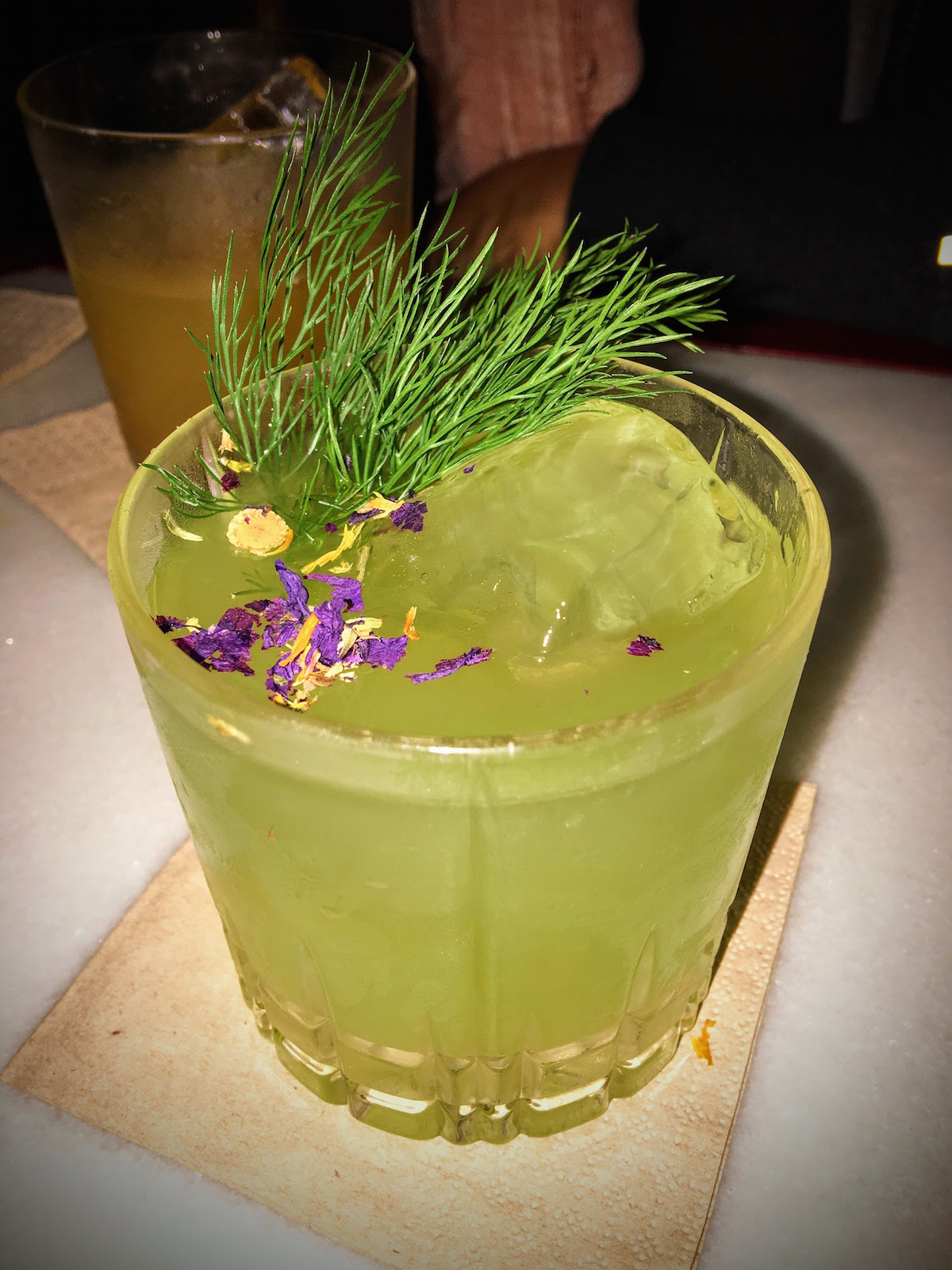
A small number of Barcelona mixologists are masters at the art of combining vermouth into a delightful — and delightfully herbal and natural — cocktail, which is pretty much the opposite of your average mixed drink in your average bar.
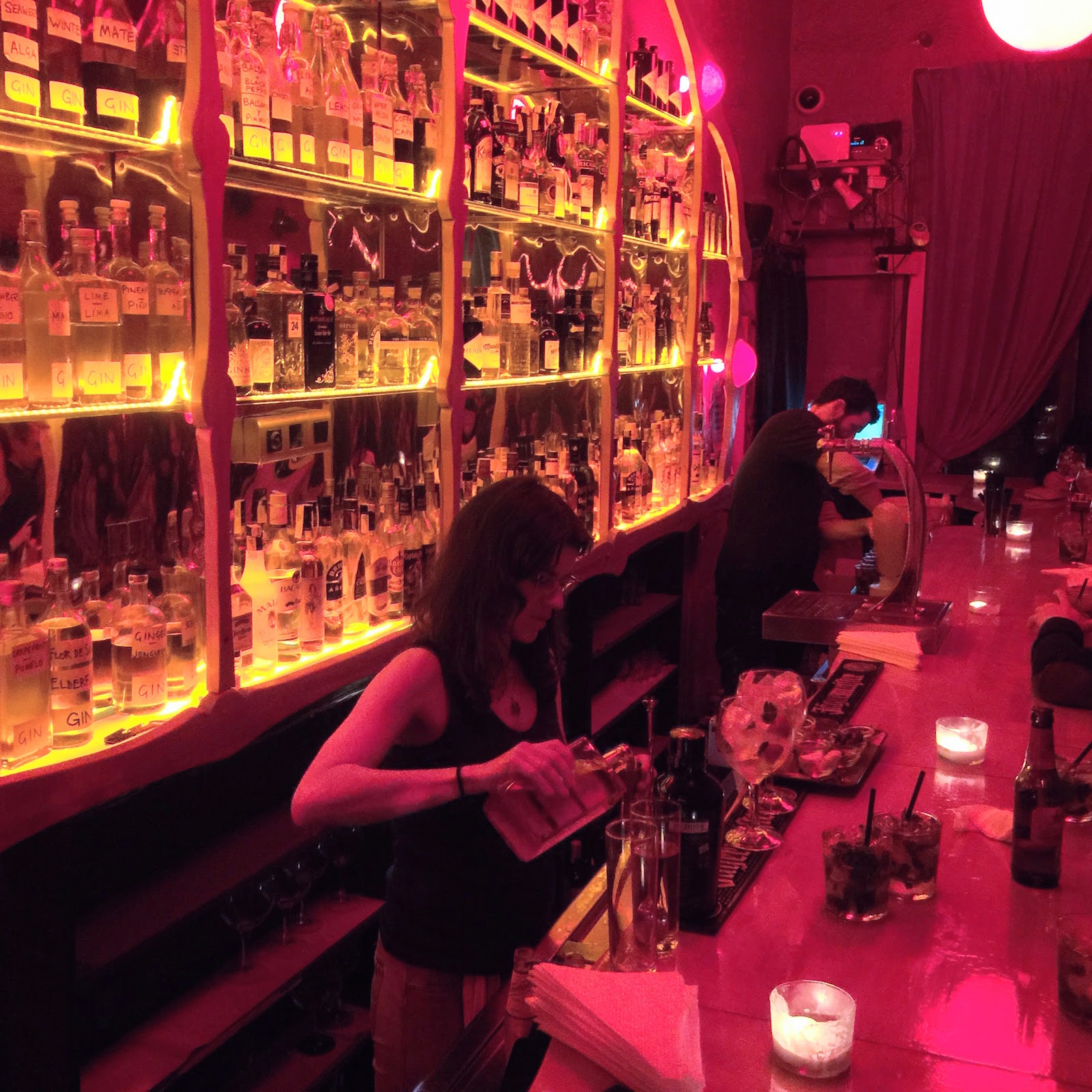
Several Barcelona bars also make their own amazing gin. Interestingly, gin started out as a medieval medicine. And the gin you find at ordinary bars still does taste both medieval and medicinal — like some kind of industrial solvent.
But some of the gin I've tried in Barcelona is positively delightful in its herbal complexity.
Of course, we're going to spend some quality time enjoying the very best bars in Barcelona during our Barcelona Experience 2017.
We're not Muslim, but we were invited by our host in Fez, Morocco, to join his family in breaking fast for Ramadan.
Travel is fatal to prejudice
In The Innocents Abroad, Mark Twain wrote, “Travel is fatal to prejudice, bigotry, and narrow-mindedness, and many of our people need it sorely on these accounts. Broad, wholesome, charitable views of men and things cannot be acquired by vegetating in one little corner of the earth all one’s lifetime.”
And Twain is right, according to science.
A series of five experiments at Northwestern University and Columbia University found that the more countries a person visits, the more trusting they become of people generally. The researchers found that the time spent in each country doesn’t matter. Only the number of places and also how different those countries are to the participants’ home countries — the more exotic the country visited, the more trusting the visitor becomes.
I think something simple is happening here. In general, people naturally assume foreigners are more different and less trustworthy than the people in our own communities and nations. But when we travel abroad, we learn the truth — that people are in fact more similar and more trustworthy than we used to assume. Given enough travel, if I discover that people in this country and that country and yet another country are essentially just like me, I’ll trust not only the people in those countries, but also humanity in general.
And that sense of trust and empathy will apply to different groups back home. With enough travel, it becomes nearly impossible to hold racial, ethnic, socioeconomic or other biases against any groups or individuals. The power of divisive constructs fizzles, and the importance of group affiliation, national borders and other artificial labels fade. In other words: “Travel is fatal to prejudice.”
( Subscribe to my free email newsletter: http://gastronomad.net/newsletter/ )
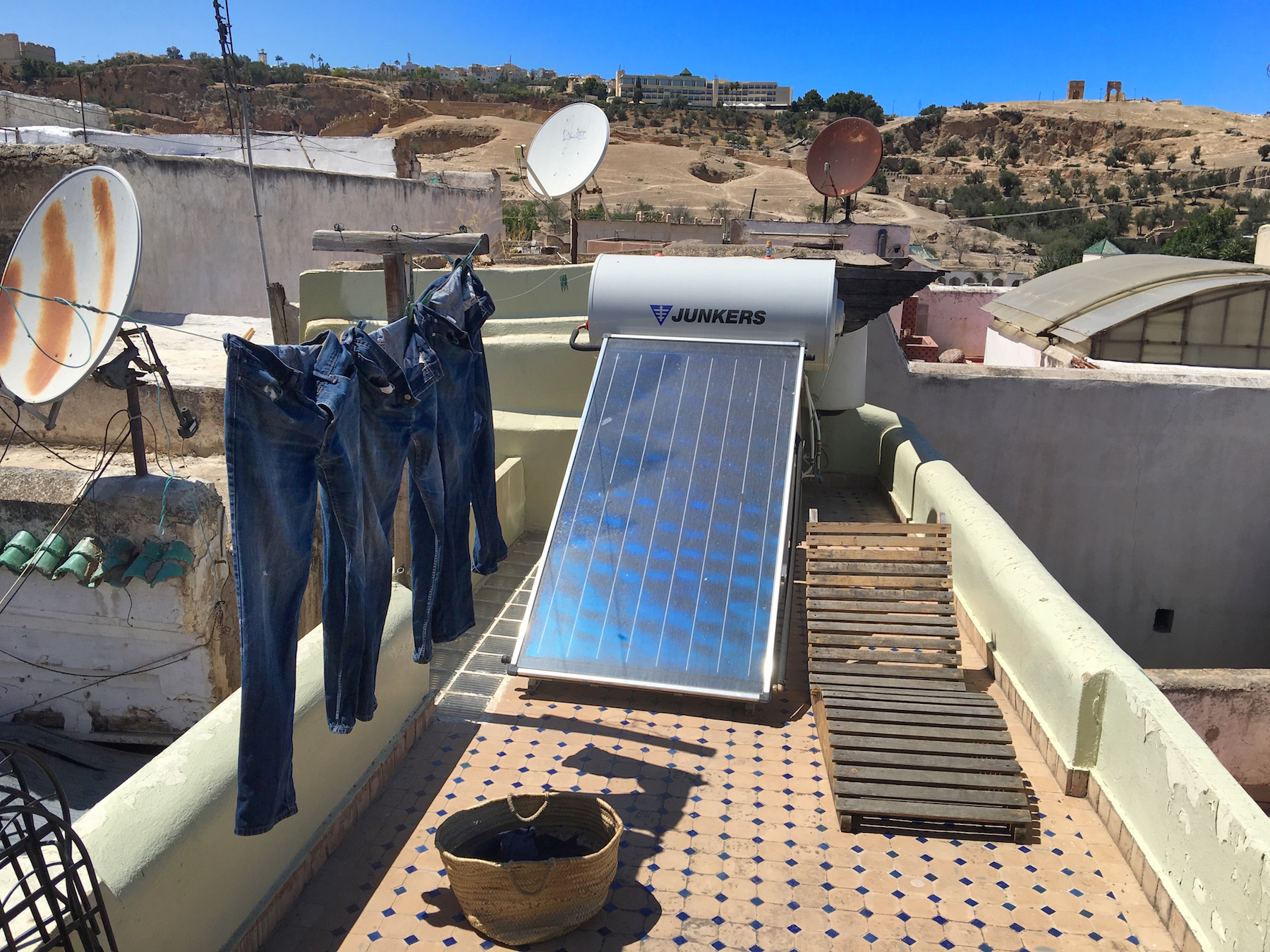
Drying my pants using solar and wind energy
Our house in Fez has a clothes dryer, but we're opting for using solar and wind energy, of which Morocco has plenty.
Get our free email newsletter! (It takes 3 seconds to subscribe!)
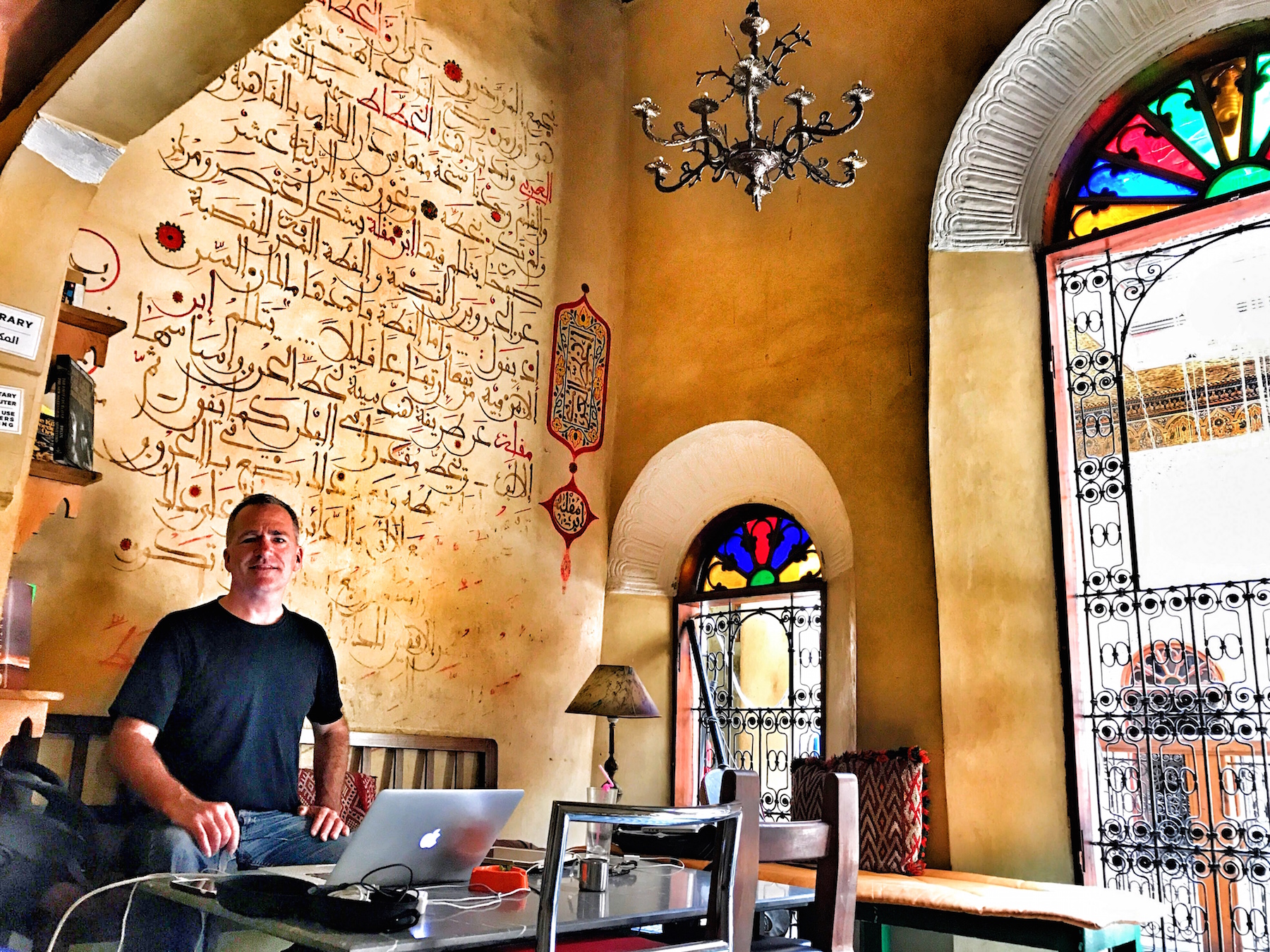
My office today: Cafe Clock in Fez
Cafe Clock is a great place to work here in Fez. It's an old riad converted into a restaurant. As with many old houses in Fez, it's four stories high with random rooms all over the place and a nice, shaded terrace overlooking the medina.
This spot is my favorite, because it's semi-private and gets a pretty good WiFi connection.
Get our free email newsletter! (It takes 3 seconds to subscribe!)
The donkeys of Morocco
Morocco is a reasonably high-tech country. Everybody's got a mobile phone. The cars are all pretty new. WiFi is everywhere. The house in Fez where we're now living even has home automation stuff all over the house, including sensors on the doors and motion detectors for the lights.
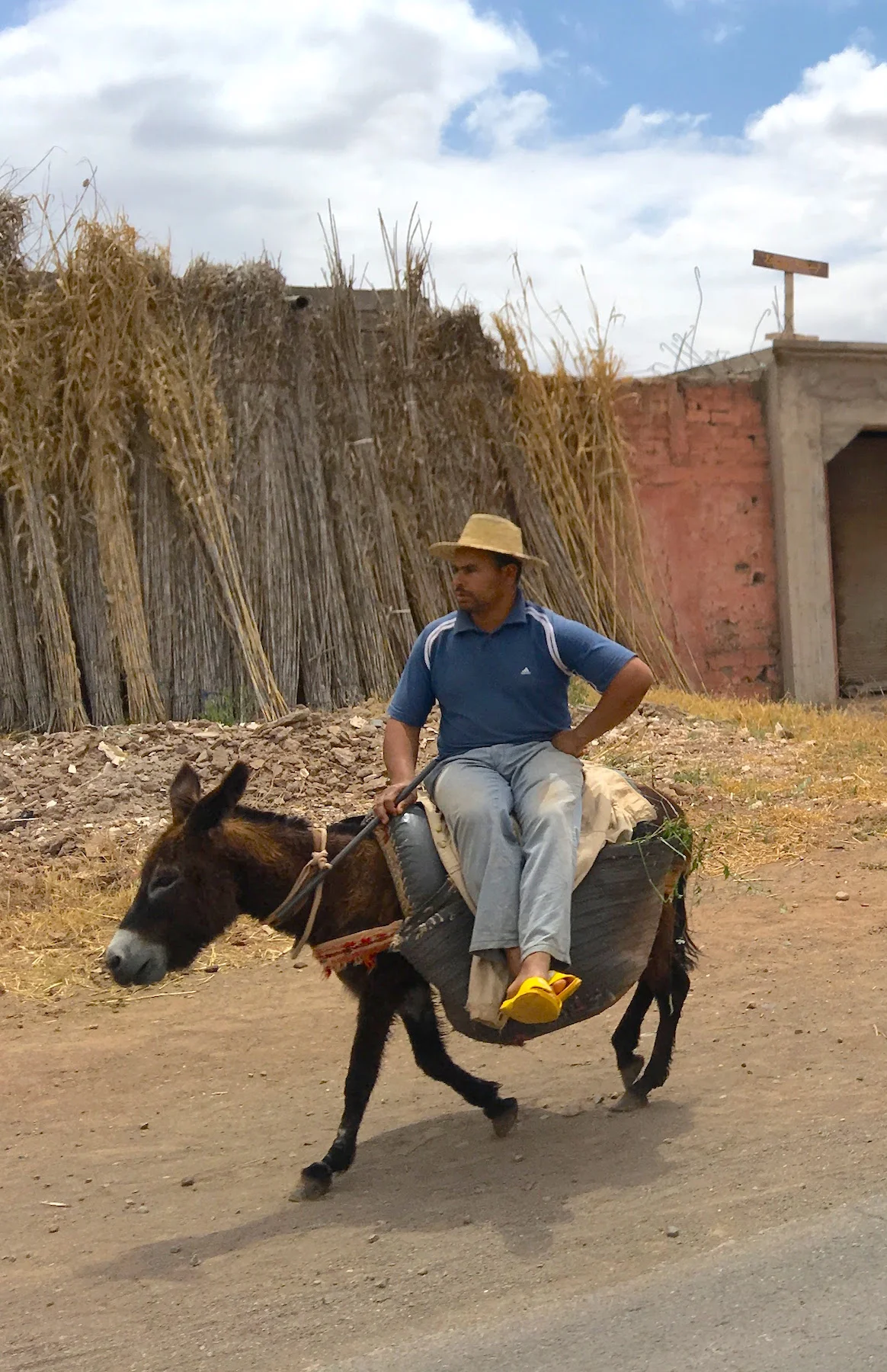
Still, donkeys still do a lot of the work here. They serve as transportation, as well as "trucks" for carrying stuff.
This is especially true in the Fez medina (the ancient part of the city). The narrow, winding Mediaeval streets here can't handle scooters, which are banned. Wheeled cars, pushed by men, are used, but they struggle to get through the crowds of people.
Only donkeys can make it through the medina carrying heavy loads, and they're used for just about everything. Some guys are controlling three donkeys at once, usually with voice commands.
Get our free email newsletter! (It takes 3 seconds to subscribe!)
Smartphones and Sunsets in the Sahara
I write professionally about the cultural changes brought about by technology, which is often smartphone-centric technology.
Most American smartphone users, especially business owners, also use laptops, tablets and probably servers and other advanced business technology.
I met a young entrepreneur this week who is running his entire startup from two phones.
His name is Mohammad, and he's a Berber Moroccan who, along with his brother Said and their uncle, are building a tourism business in the Sahara desert.
Before I tell you more about Mohammad, first let me tell you about his travel business.
It's called Trips Around Morocco. Right now, they offer camel rides, camel rides to overnight desert camps, guided driving tours all over Morocco, and they're building a hotel they say should be done in six months.
I love their business. And I'm not alone. They have perfect reviews on Trip Advisor.
We encountered Trips Around Morocco when Amira discovered them after extensive research. We wanted to experience a night in the Sahara, so she booked their camel-ride-to-Berber-camp package.
We arrived at a hotel-like Berber-style building, which was like a holding area for tourists waiting for departure into the desert.
There were two groups. One was a group of eight visitors from China. The other group was Amira and me.
At the appointed hour (they time the trip to coincide with the setting sun), we walked out over a flat gravel plain to the waiting camels, which were tied around their front legs and sitting on the ground.
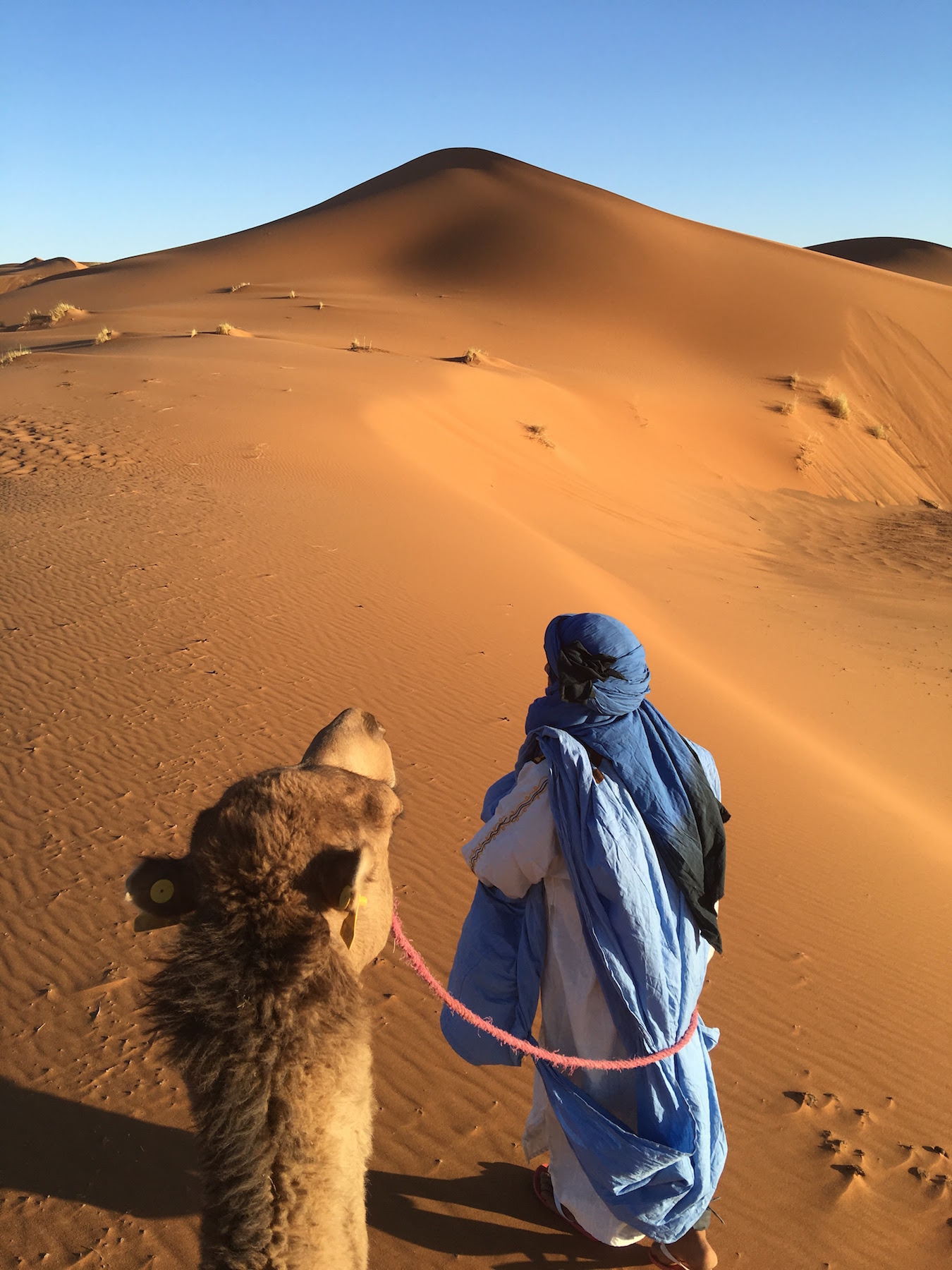
Mohammad wrapped Amira's scarf around her head and face Berber style to protect from sun and sand. They assigned a camel each to Amira and me. We straddle them, they got up, and one of the staff — a guy in his early 20s whose name I don't recall — walked through the sand in his flip-flops guiding the camels. We three humans and two dromedaries sauntered through the sand, leaving the other group behind.
(Note that it was the first day of Ramadan, so these guides are walking for miles through the Sahara in direct sun with zero shade without drinking water or eating anything since 3:30am.)
We were immediately in the dunes, which were breathtakingly beautiful, a deep orange color that deepened as the sun sank on the horizon.
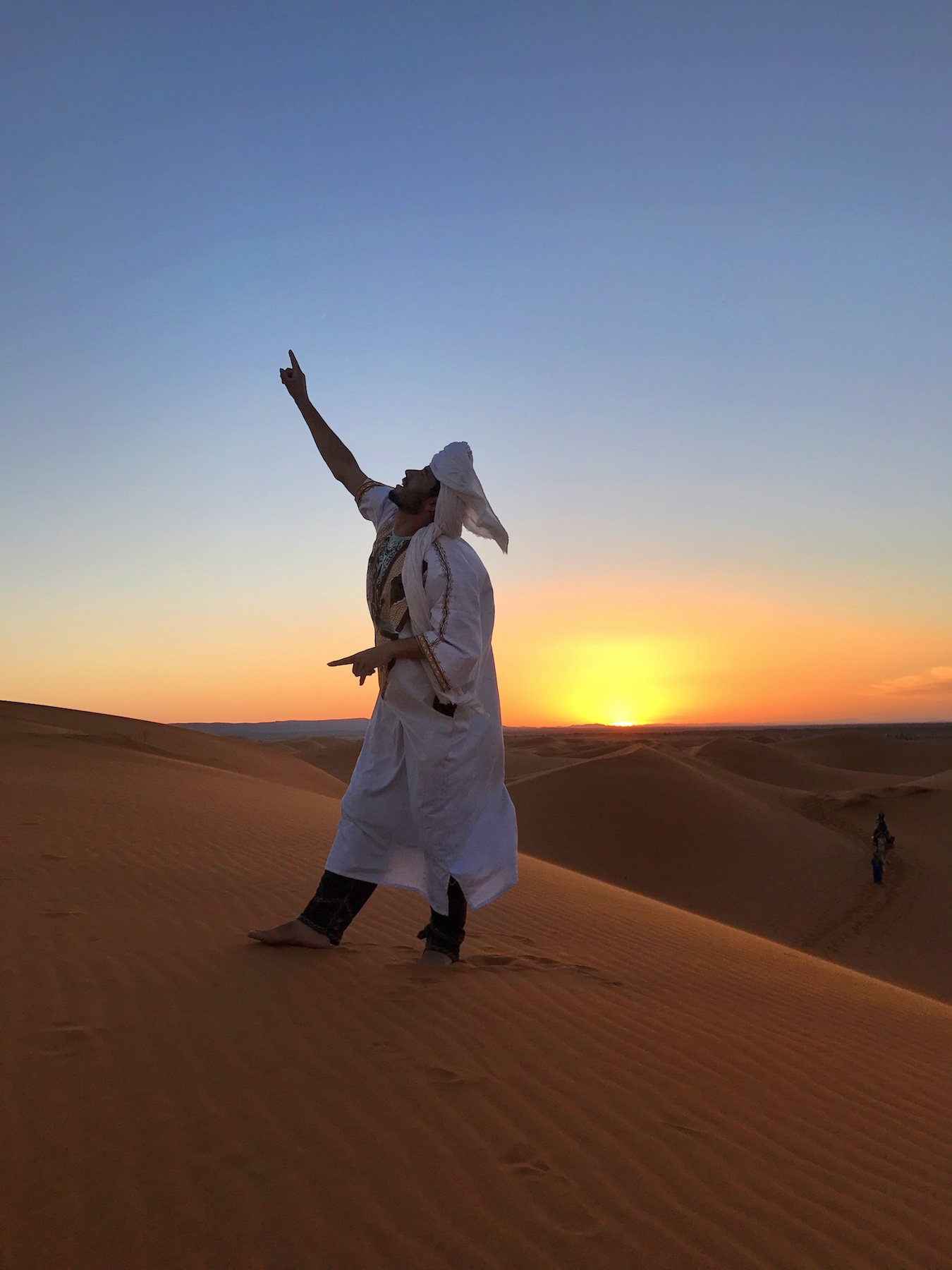
After about 45 minutes of travel, our guide "parked" the camels, and invited us to the top of a very high sand dune to watch the setting sun. He sprinted up the dune like he was being propelled by jets. We awkwardly groped our way to the top over time, struggling mainly to avoid burying ourselves in the sand-avalanches we were creating.
We spent probably a half hour on top of the dune taking pictures. Eventually, Mohammed showed up with the Chinese group. He posed for some pictures with us (really hamming it up). Every once in awhile, he checked his two mobile phones — one an Android smartphone and the other a tiny feature phone. (More on that later.)
After the sun set, we came down from the dune, mounted our steeds and rode another ten minutes to the camp. As our guide was dealing with the camels, he told us the camp was over a dune and that we could proceed. So we did, and there it was — 10 camel-hair Berber tents arranged in a U-shape.
The camp had one Berber camp guy, who spoke no English but did speak some French. He showed us our tent and told us we should go have tea at a picnic table in the center after freshening up. (The spacious tents had showers, flushing toilets and sinks inside — not sure how they do that...)
We arrived at the table, and tea was ready. But our host was gone. It was just Amira and I in the camp, alone for about 20 minutes. My guess is that they went to a nearby place or SUV for "iftar" (the breaking of their Ramadan fast), guzzle water and wolf down some food.
Around this time we realized that we were the only guests at the camp. The Chinese group had gone to the "luxury camp," which had plastic tents and other luxury things.
Our camp guy brought a bottle of cold water, and eventually a tagine, as well as some bread and fruit.
We had brought some cherries we bought at a roadside stand outside Fez and Mohammed and the guys were gobbling them up (they don't grow cherries anywhere near the desert). We couldn't eat them all, and Mohammed took the remainder to break his fast with at 3am.
We had been eating tagines all over Morocco, and we expected the food to be bad. They were, after all, camping in the desert.
But the chicken tagine (which also had hard-boiled eggs, olives, potatoes, beans, onions, etc.) we were served was by far the best tagine we've ever had in Morocco. It was incredibly delicious.
After this amazing dinner, Mohammed, two guides and our camp host all played drums and sang Berber stuff, inviting us to join in. We then got to talking with Mohammed, and learned more about his business.
He had worked for years in restaurants and hotels and saved up as much money as he could. His brother and uncle saved, too, presumably. He then went into business for himself buy buying two camels, and provided desert camel rides to visitors.
Over time, they expanded into driving tours, camps and began construction of a hotel.
We talked late into the night, and Mohammed occasionally checked his phones, explaining that when he got a booking or post on Trip Advisor, he would get a text message alert on his feature phone.
By climbing to the highest nearby dune, he could actually get cell reception good enough to reply to queries, confirm reservations and so on. He told us those two phones were his only "computers" upon which the entire business was run.
Amira made sure to book when the sky was clear and the moon at its least visible, a sliver in the sky. The stars were mind-blowingly clear and numerous.
We asked the guys to set up a bed for us outside our tent so we could sleep under the stars. They actually put a full bed there, with sheets and heavy, warm camel-hair blankets.
So we retired, and watched the stars. We saw dozens of shooting stars. As we were falling asleep, the Milky Way was rising over a dune to the East. Amira woke up in the middle of the night, and it was directly overhead, an awesome cloud of light spanning the sky.
Next morning, our camp host clapped his hand from his bed (he was sleeping on a rug on the sand) and said "sunrise!, sunrise!" until we got up.
We clambered up the dune, watched the sunrise, then grabbed our gear and headed back to the camels. (Most of the time, they serve breakfast in the camp, but because it was Ramadan they served it back at HQ.)
At the staging area, we were the only guests. The served us a generous breakfast. They offered us showers, but we declined.
Our driver came out (he had been doing Ramadan feasting and napping all night). And we took off.
Mohammed and his family are providing mind-blowing, bucket-list experiences for people from all over the world.
They're really doing is sharing a bit of their culture and environment with visitors to Morocco, and it's a magical experience.
Join us in Morocco for The Morocco Gastronomad Experience!
My office today: a rooftop terrace overlooking Marrakech's Jemaa el-Fnaa square!
It's Ramadan, so Moroccan tourists are light on the square below.
(Took me two hours to post this. WiFi is not exactly what you call fast here.)
Get our free email newsletter! (It takes 3 seconds to subscribe!)
The Medina Diet
Here in the oldest part of Fez, called the Medina, there are five kinds of food available from the hundreds of stalls that line much of the area.
The first kind is expat tourist chow. These restaurants are owned and operated by Brits or Americans or Spanish people and they bring an international sensibility, and often acceptable WiFi, to the dining experience. I had a camel burger yesterday at one of these places. Moroccans generally don't eat camel burgers. But I love such places because you can often hang out there for hours, use their WiFi and work.
The second kind is locally owned tourist chow. These are restaurants and food stalls designed mainly for tourists but conceived and run by locals. They often try to provide an "authentic" Moroccan experience for foreigners.
The third kind is locally owned snack foods for locals and tourists alike. These businesses offer ice cream cones and lemonade and other foods that you can find everywhere in the world.
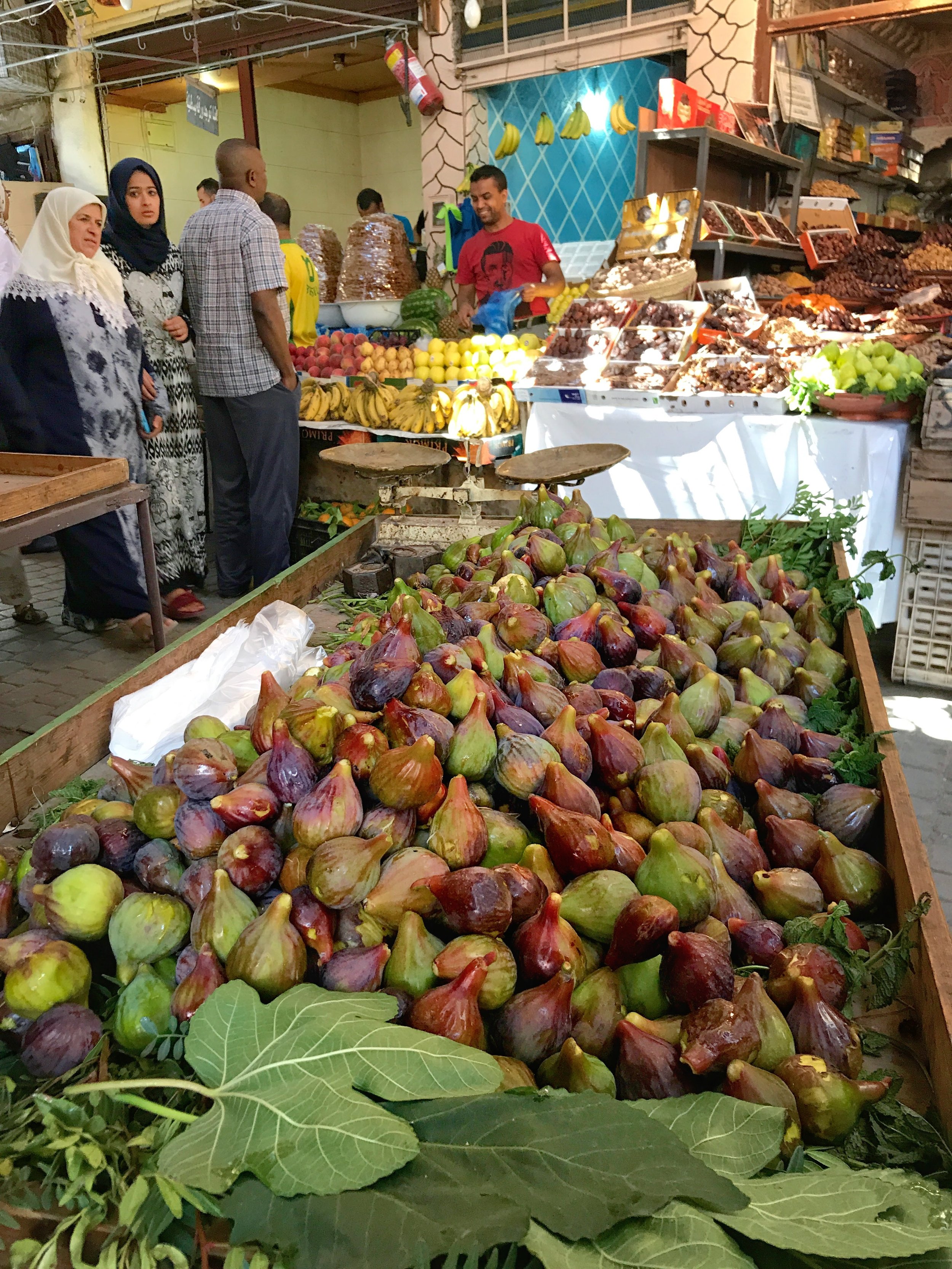
The fourth kind is locally owned food places mostly for locals, but which some visitors also buy at. These businesses sell Moroccan style bread, dates, olives, produce and other foods that are aimed mostly at locals. Some of these have actual dining rooms off the street, but they often do some or all the cooking on the street. Some of these are frequented by locals only because of their location. Others have a small percentage of foreign customers because they're on the major thoroughfares.
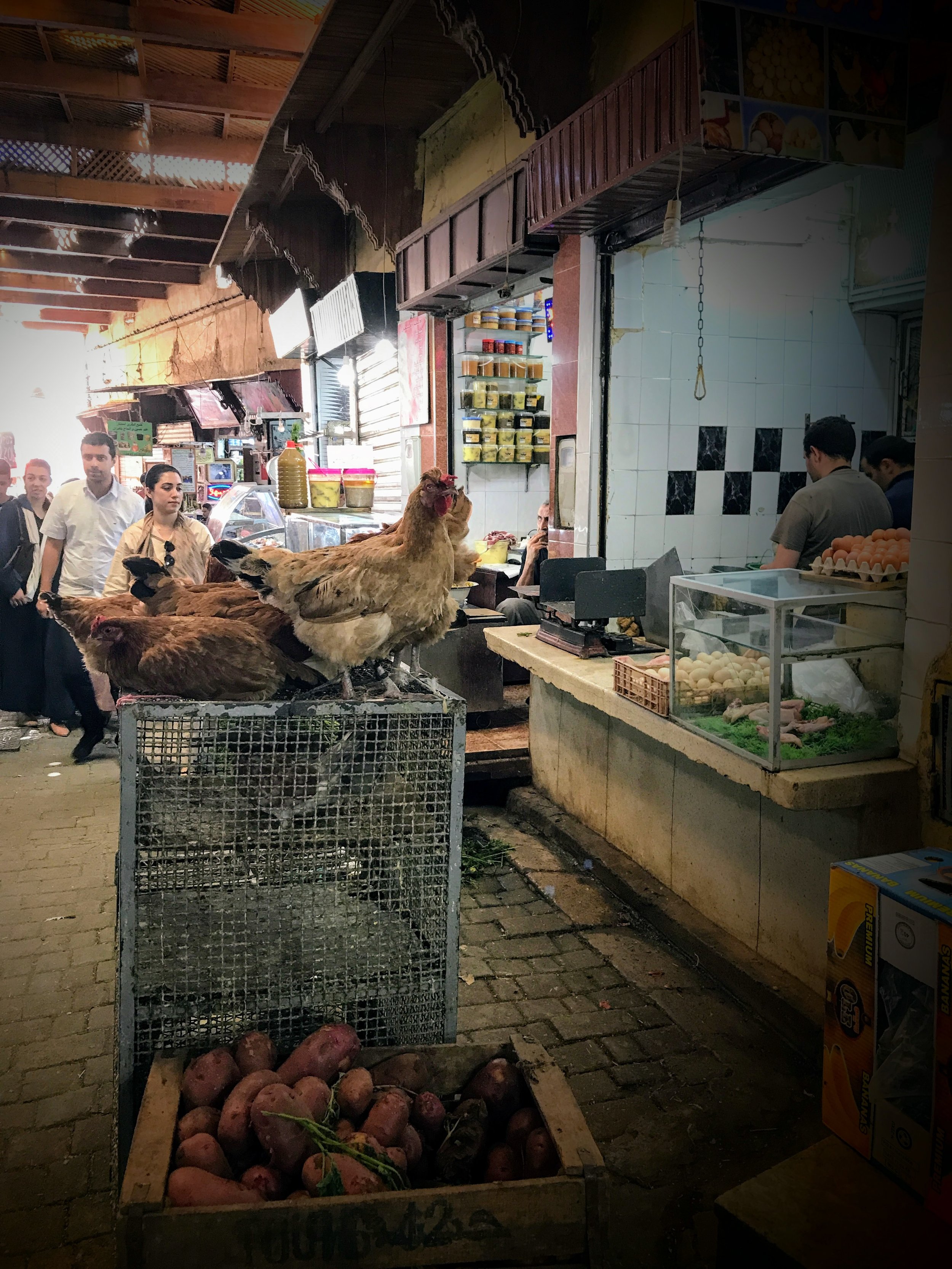
And the fifth kind is local-only-local food. People are selling live chickens and stuff like that that tourists aren't going to buy under any circumstances.
We do consume some of the first kind — expat tourist chow, because the space they provide is best for working (especially if they have roof-top tables where the WiFi reaches).
But our main diet is the fourth kind — locally owned food places mostly for locals. We're mainly on what I call the Medina Street Food Diet. Last night was a perfect example.
We spend most of the day at Cafe Clock, which is an ancient riad converted into a restaurant by some expats from Europe or America — not sure. We started out on the second level, but after a few hours it got hot so we moved to the rooftop. I drank coffee, and a little mint tea. We ate a little and worked a lot.
As the sun was setting, we headed back to our riad. We stopped at stall that sells awesome pickled veggies and olives, and grabbed a bag of each. They we found a guy with a bread cart, and picked up a Frisbee-size disc of Moroccan bread from him. In our riad, we had farmer's cheese we got the day prior from a guy with a stand at the entrance to the Medina. Plus we augmented this with olive oil we bought in Spain.
The aforementioned cheese guy let us try all the stuff he was selling. One was milk fermented in a glass. It's like kefir, but they add the milk to a glass (it has a liquidy custard-like texture but very mild flavor), and the glass sits there all day in the open, unrefrigerated. He also had a huge bucket of buttermilk, and you could see big chunks of butter floating in it. We tried it all and it was all delicious.
Other street vendors sell various sweets, covered in pastry dough, deep fried and drenched with honey or simple syrup. They keep these in big glass display cases, each of which may contain hundreds of wasps flying around and landing on the sweets. (We didn't have them because they're deep-fried.)
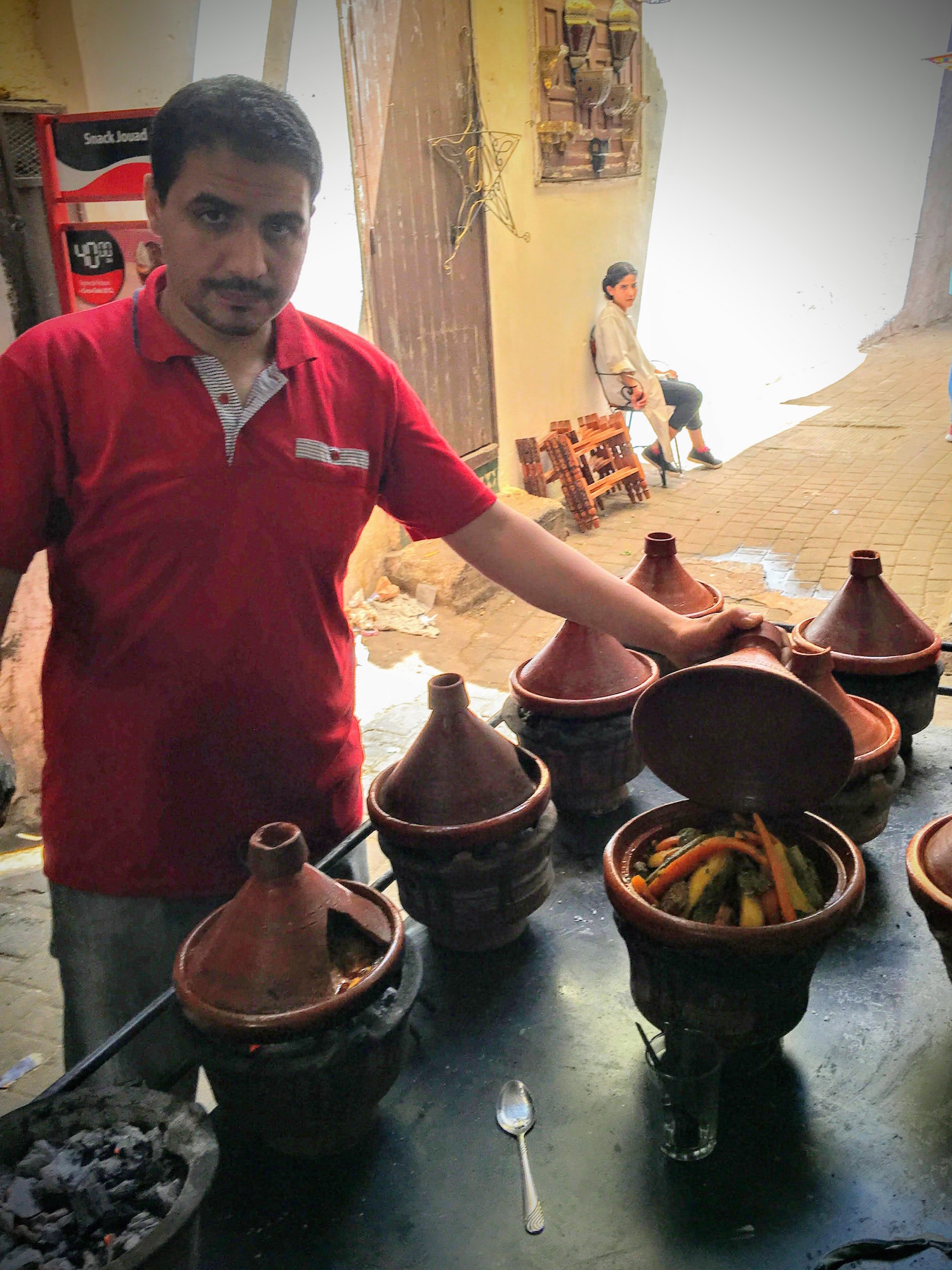
Another example was our lunch today. We were on our way through the Medina on our way to some WiFi, and spotted a big metal table full of tagines. The place looked totally legit, with an interior dining room with 100% of the customers were locals. So we asked for a tagine and a couple salads, and they brought it all, plus bread. We ate it with our hands local-style. It was delicious.
Americans are often freaked out by street food. The vendors are handling things with their bare hands. Refrigeration is non-existent. Things aren't covered.
My son, Kevin, has always been a reckless connoisseur of anything sold out of an outdoor cart. In recent years, I've come around to his point of view. In fact, when we were in Mexico City last year, I came to the realization how much I love street food that's aimed at locals.
I've gotten sick before while traveling. Once I got incredible gastrointestinal problems from coffee I bought from a Honduras gas station. I got super ill from Cuban Zika fumigation. But I never got sick from street food. Ever.
We're health nuts. Some Moroccan street food is unhealthy, and we avoid it. There's lots of fried stuff, and other foods are loaded with sugar. The bread is industrially leavened, as is the case with most of the bread in the world. (These are often modern versions of traditional foods that were baked instead of fried, sweetened with honey and dates instead of sugar and fermented with starter instead of yeast.
Other Moroccan street food is healthy, such as the range of fermented milk products, olives and other fermented and pickled vegetables, and of course natural produce, including dates, and we're living on that stuff, mostly. Lots of vendors sell soup, sandwiches and stuff like that. We do have bread but keep it limited in quantity (some foods like tagines and sandwiches really need the bread).
(Interestingly, most of the fermented milk and soups come in glasses or ceramic bowls — you stand there and have it, then hand the vessel back.)
The best stalls always have a crowd of locals clamoring to buy, and these places are worth the wait.
In any event, we're living mainly on the Medina Diet. (In fact, to a very large degree, we came here in order to be on the Medina Diet.)
Today it occurred to us that we have so much food to explore, and so little time.
Get our free email newsletter! (It takes 3 seconds to subscribe!)
My office today: The Bliss Riad in Marrakesh
Wow, I love this riad! Beautiful rooms, awesome staff, great food.
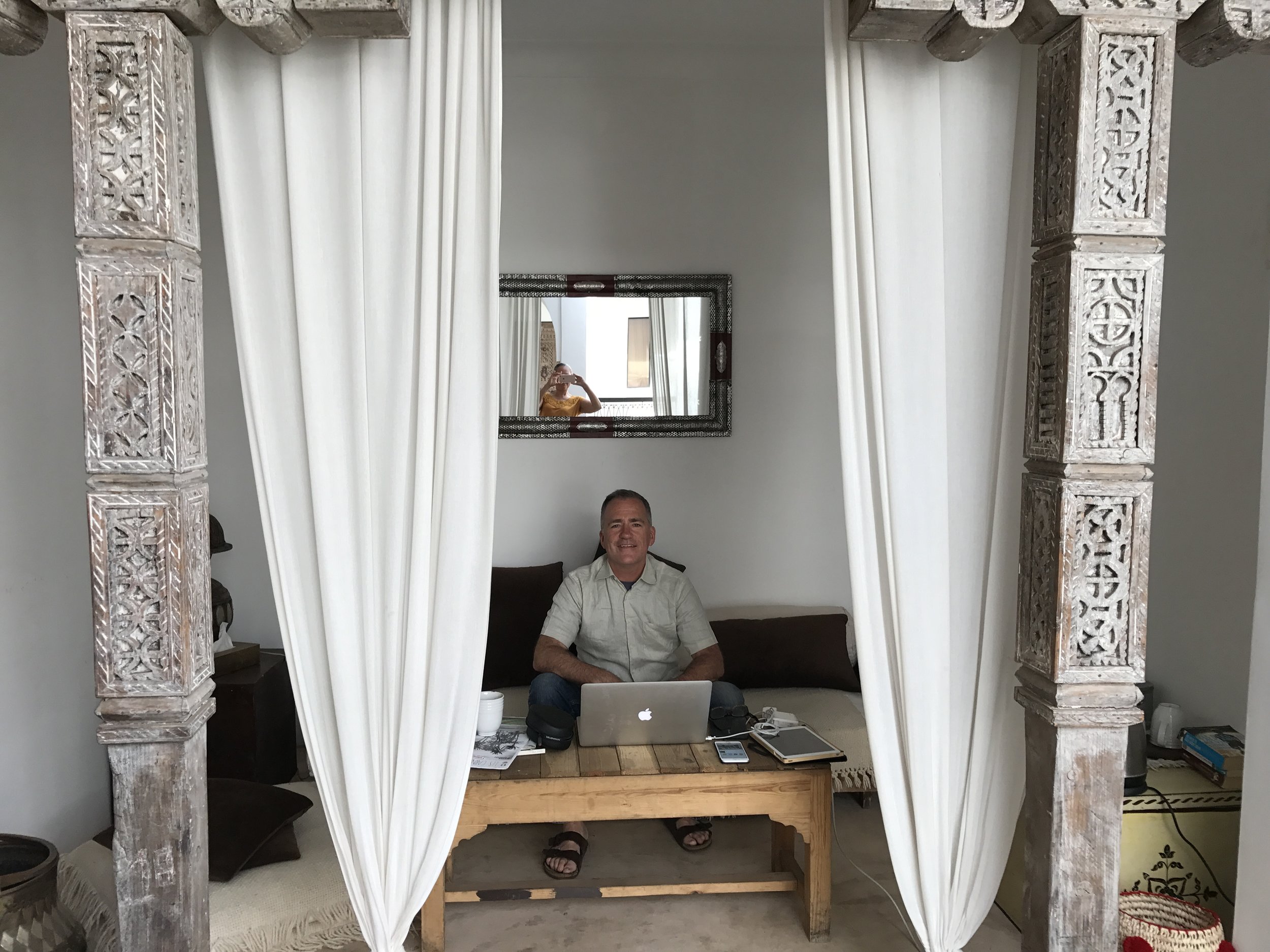
Best of all, plentiful nooks and crannies like this for getting work done. This one, on the same floor as our room, has a handy outlet, great WiFi connectivity and an electric tea kettle where I can make my own coffee and tea.
This is the perfect place to work, I tell you.
Get our free email newsletter! (It takes 3 seconds to subscribe!)
#morocco #Marrakesh
My office today: Ait-Ben-Haddou in Morocco
After driving all day across some incredible desert landscapes and checking out a 300-year-old kasbah (fortified mud house), we arrived at our hotel, which has a balcony with a great view of the red citadel of Ait-Ben-Haddou.
Hollywood loves the citadel, that hill behind me. It appeared (with massive CGI upgrades) as the city of Yunkai in "Game of Thrones" and without enhancement in a couple dozen movies, including "Kundun," "Gladiator," "Alexander," "Kingdom of Heaven" and most importantly, "The Mummy."
Photos, videos, TV and movies usually show the other side — this is the backside.
This fortified village sat on the the medieval caravan route between the Sahara and Marrakech.
WiFi is slow, but there are outlets here and food, tea and coffee service from the hotel's restaurant. Plus the view. Overall, a great place to work.
Get our free email newsletter! (It takes 3 seconds to subscribe!)
For the Love Of Tapas
One of the great joys of living in Spain is tapas culture. In its purest form, the enjoyment of tapas involves long evenings drinking slowly and talking rapidly. Each new round of beer or wine is accompanied by a small plate of delicious food traditionally chosen and paid for by the bar.
One joy about tapas: the element of surprise. No paralysis of choice. No buyer's remorse. You get what they give you. There's no menu. There’s no charge. It's wonderful.
Great tapas are one of the greatest food experiences you can enjoy.
Tapas are mostly an Andalusian thing. Outside Southern Spain, tapas often work differently.
Here's Barcelona's dirty little secret: Great tapas this town are hard to find.
There are two main reasons for bad tapas in Barcelona.
Many tapas restaurants list tapas on a menu, and charge for each dish individually. There's nothing wrong with that. In fact, it's a good thing, because it enables tapas to include more expensive ingredients and for the customer to be charged accordingly.
But most Barcelona tapas restaurants list their tapas on a permanent menu. And that's a problem.
Tapas tend to be best when they're assembled with ingredients of opportunity — seasonal produce, seafood that happens to be abundant in high quality on a random Tuesday, that sort of thing. Constructing an all-year, every-day menu means tapas bars will exclude seasonal ingredients and special ingredients.
There are ways around this, of course. Some tapas bars offer "specials" of the day or simply inform customers which items on the menu are unavailable.
The biggest problem with tapas, however, is when they're designed for tourists rather than locals.
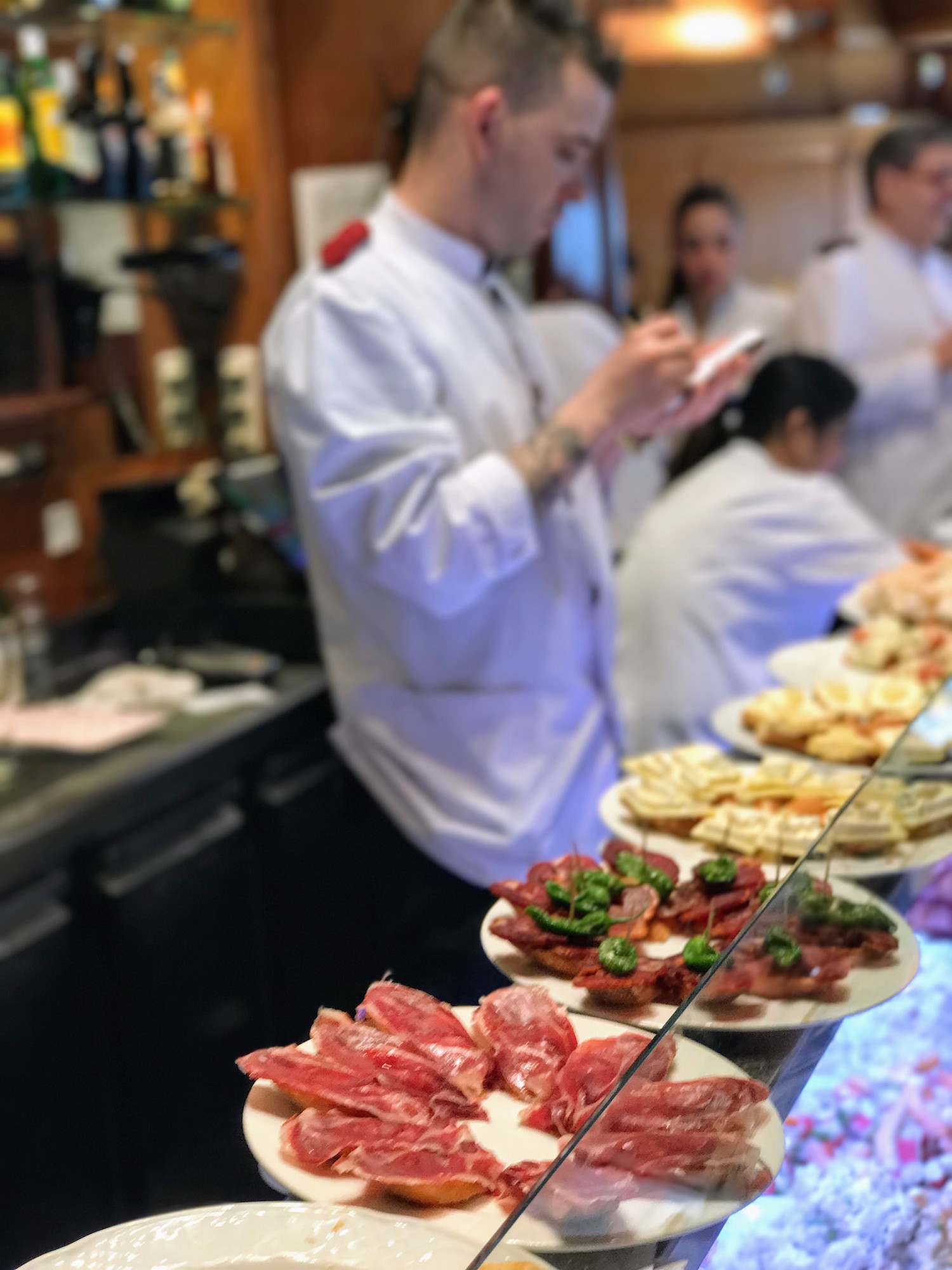
Here in Barcelona, tapas bars are everywhere. Instead of tapas being made constantly and coming fresh out of the kitchen, they're often pre-made in large quantities, then displayed and stacked on plates on top of a counter top in a way visible to passers-by. Bars try to be more impressive by making large quantities and showing them off in large stacks.
Technically, these aren't tapas. They're called pinchos. And they're sort of like the Basque version of tapas. Unlike tapas, pinchos are not traditionally "free." You pay for them separately from drinks. Most pinchos involve something placed on top of a slice of bread with a single toothpick holding it all together. Sometimes they add up your "bill" by counting the toothpicks left behind.
A typical scenario on major tourist thoroughfares in Barcelona is a charming old-looking establishment that says "Tapas" on the outside, but with pinchos on the counter. That's the winning combination. The reason is that tourist are more familiar with the word "tapas" but pinchos are stackable and impressive.
In the tourist places, these stacks of pinchos often sit there for hours. The bread is getting soggy and stale simultaneously. Grime and dust from the city are coating them. Making matters worse, items are designed to survive this ordeal and still look vaguely edible by the time they eventually reach somebody's mouth. So they tend toward big slabs of meat or fish, and entire categories of tapas and pinchos are eliminated.
In other words, when you're targeting tourists, tapas don't have to taste good. They don't even have to be tapas. They have only to look good. So all effort is focused on the appearance and ingredients, food handling and other aspects suffer. Tourists aren't going to become regulars anyway, so no harm done to the business if the food sucks. (In real tapas culture, each bar is in a contest with the other bars for the affection of regulars.)
Another problem is that Spaniards like to close their shops for siesta, national and local holidays, and for family time when the kids are out of school. In a tourist-intensive city like Barcelona, non-Spanish tapas bar owners (immigrants from Asia or the Middle East, mostly) have an advantage. They stay open during siesta and holidays, and can thereby make a lot more money — enough to pay inflated building rents in heavily trafficked areas.
All this results in the proliferation of tapas bars in tourist areas that aren't owned by Spanish people, aren't coming from tapas culture and don't have good tapas and they advertise with mishandled pinchos. These bars are a simulacrum of real tapas bars, but the tourists keep them in business.
Tapas and pinchos are like pizza. Even when they're bad, they're still pretty good. And when they're good, they're spectacular.
The good news is that incredibly great tapas and pinchos bars do exist in Barcelona, and we have found them all.
During our Barcelona Experience 2017, we're not going anywhere near tourist tapas. We're going straight to the best tapas made with high quality and seasonal ingredients that are fresh and made to order. And, of course, we’ll enjoy some freshly made pinchos, too! Come and experience the real Barcelona with us and the best bar food this beautiful city has to offer.
There's nothing in this whole world like great tapas and pinchos in an authentic or visionary bar in Barcelona. You simply MUST experience this.
Get our free email newsletter! (It takes 3 seconds to subscribe!)
My Top Tapa To Date
I love me some tapas. And, of course Spain is tapa heaven.
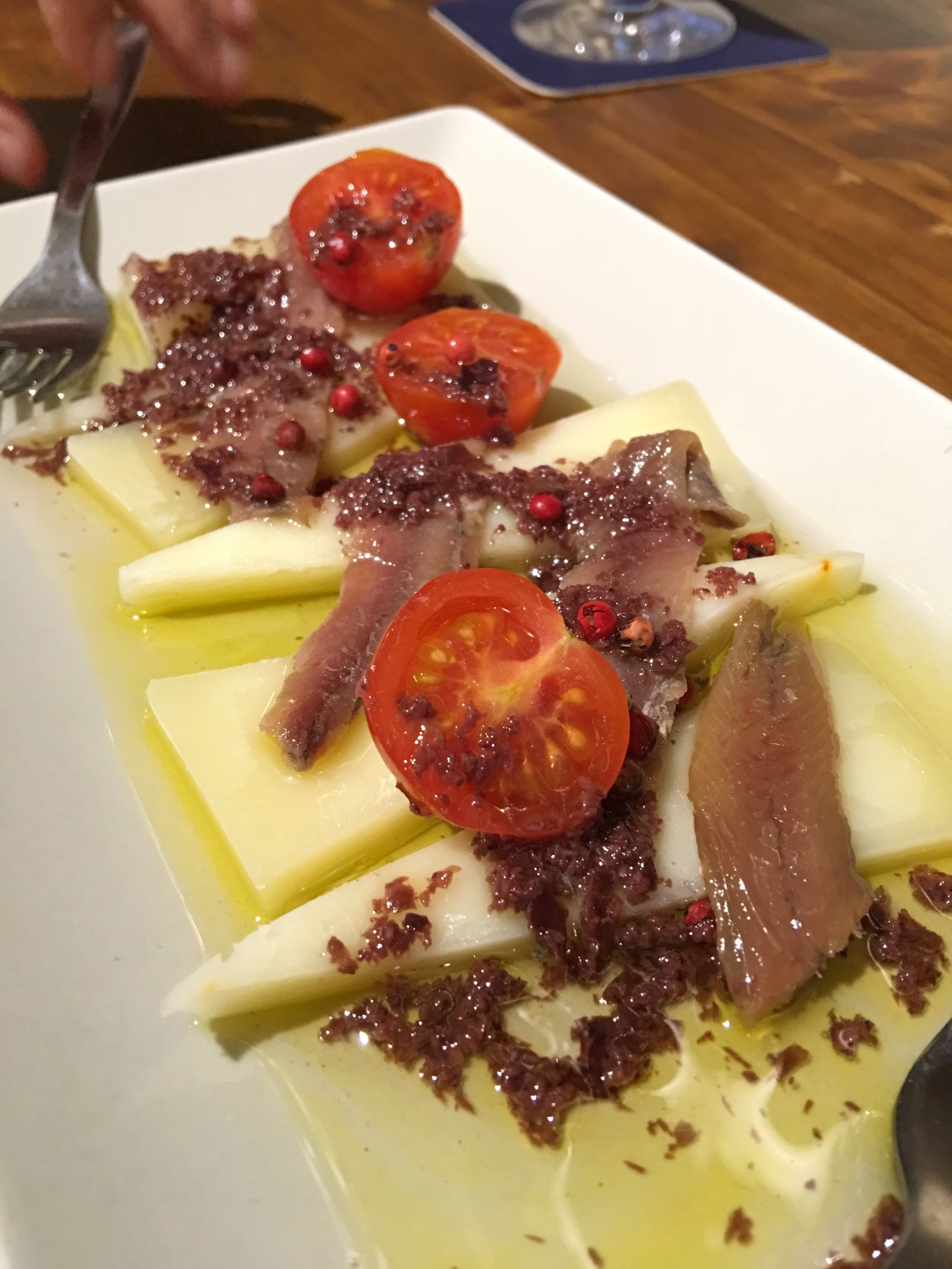
So far, my favorite tapas came in the form of manchego cheese topped with anchovies, mashed olives, peppercorns and cherry tomatoes, then drizzled with olive oil.
So. Fricken. Delicious.
(Join us for our Barcelona Experience 2017! We're definitely having this!!)
Get our free email newsletter! (It takes 3 seconds to subscribe!)
My office today
This is a nice little cafe that has great beer made in-house and a seat in the window.
Join us in Barcelona in September!
Get our free email newsletter! (It takes 3 seconds to subscribe!)
The Joy of Wandering Around
One advantage of nomadic living over tourism is that you can make the time to discover more.
We're here in Barcelona, and Amira is preparing for our Barcelona Experience 2017 event. Those preparations are both systematic and unsystematic.
The systematic planning involves countless hours researching, and also grilling friends and contacts in the city in search of Barcelona's most amazing food experiences. We then go there, meet people, try things and learn more.
The unsystematic approach involves walking around. This is my favorite kind, and we did this for about 8 hours yesterday. During this time, Amira had mapped out six or seven food places (restaurants, bars) and we checked them out. En route, we explored every interesting thing along the way. Sometimes a discovery leads to another which leads to another — for example, you find an amazing restaurant serving amazing bread. Then we find out where the bakery is, check it out, and learn about a new food visionary bakery doing amazing things. We get to know the baker, who introduces us to an amazing wine-maker we otherwise would never have discovered. Etc. Which is... amazing.
We've been doing this for years in Barcelona, having lived here several times for many months each time.
In any event, this wandering around process takes months in any given city. It's a lot of fun. But it's time consuming.
By the way, we still have spots open for The Barcelona Experience 2017! Join us!
Get our free email newsletter! (It takes 3 seconds to subscribe!)
Under the cava country
In our search for Catalonia's greatest food secrets, we've had to look beneath the surface. Literally!
Our quest took us to the cava-producing region near Barcelona. As with Italy's prosecco-growing area, the places where cava is produced is mind-blowingly beautiful, with rolling hills of vineyards, ancient farm houses and tiny villages, each wrapped around a medieval church. (The region is also dotted with bunkers and other painful reminders of the Spanish Civil War.)
A few decades ago, every sparkling wine was called "champagne." But Champagne is a wine-growing region of France. With the rise of the EU, French producers were able to ban the use of "champagne" for any sparkling wine produced outside the area. (You can still see wine buildings in Spain that say in faded paint "champán," the Spanish spelling of "champagne.")
In response, California producers in all their utilitarian artlessness started calling it "sparkling wine." Italians renamed it "prosecco," after the village where the glera grape may have first been developed. And Spain called it "cava."
Cava, it turns out, is Latin for "caves" — the place where grape juice is transformed, and later where bottles are stored for aging. And, boy, are there a lot of caves in cava country.
Anywhere you go in this part of Spain, you encounter cava-producing wineries — buildings of various sizes, with the largest producers centering around building complexes that are larger than most of the towns in the area.
Beneath all these producers are deep caves where the wine is aged. In many cases, they're not stored in containers, but in tiled "rooms" whose sole purpose is to gain hundreds of gallons of cava.
Bottled cava is even stored in Civil War bomb shelters, the brick entrances of which pop up randomly in vineyards.
These wine "caves" also serve as ready-made cheese aging facilities. With a little tweaking and air management, the temperature and humidity can be maintained perfectly, even in Spain's blistering-hot summers.
Our upcoming Barcelona Experience 2017 will take us to the cava country, where we'll explore the beauty of this place, introduce you to the region's visionary food and wine makers — and also marvel at what's taking place beneath the surface.
Get our free email newsletter! (It takes 3 seconds to subscribe!)
The Heart of Barcelona
This is a classic photo of one of the typical fruit stands at La Boqueria Market.
What is La Boqueria? To me, it's the heart and epicenter of this glorious city of Barcelona, Spain.
Carefully and beautifully arranged fruit in a display of colorful art to entice the senses of even the most jaded market visitor, this is La Boqueria's signature.
I take this shot every time I come to Barcelona, in fact. It's one of the many familiar places in this wonderland of Farmer's markets.
La Boqueria isn't really a farmer's market. You won't find many real farmer's there. (The true farmer's market actually set ups in the mornings right next to La Boqueria. It's tiny, but everything's cheaper.)
There are many markets in Barcelona. In my experience, most tourists don't bother much with the other markets.
We were last here in Barcelona two years ago, which might be the longest period of time we've gone without visiting this awesome city. It's been a culture shock to see how much more crowded it is now than ever before, and it's not even peak season yet. I have never seen Barcelona, La Rambla and La Boqueria so completely packed and overrun by tourists. I get it, we all love this beautiful city so much. But the Barcelona I first visited has grown and changed enormously.
Our love affair with Barcelona goes back three decades. Mike and I first visited and fell in love with Barcelona when we spent a week here for our honeymoon in July 2007 (we also went to Italy and France). We had the most amazing time and while we had more sangria than should ever be allowed, I still remember all the magic of the city very clearly.
We want to re-capture that magic and share it with you. That's why we've launched Gastronomad Experiences!
Naturally, for our very first of these experiences, and to commemorate our love of food, wine, travel and adventure, we had to choose Barcelona!
We're here in Barcelona for one month to finalize the details of this extraordinary event (which takes place in early September. Click here for details.)
We created these experiences with you in mind. As we've had our amazing adventures abroad and find ourselves having the incredibly magical times and epic experiences, we've always wanted to be able to transport you to our table for you to share the joy with us. And creating our Gastronomad Experiences is a wish come true for us.
Mike and I try to do that everyday. It's a work in progress but the more you practice it the better you get at it. We strive to make life fulfilling, meaningful, rewarding, fun, adventurous, and joyous.
The Barcelona Experience will happen only once! (We'll never repeat an Experience.)
We'll enjoy tapas of the highest order with true local chefs. We'll experience the true bohemian side of this city. We'll learn the secrets of Catalonian cuisine. We'll explore the musical rhythms of flamenco. We'll talk to cultural experts to enlightened us about all things Catalonia and among other things, we'll be visiting the true countryside of Barcelona for a proper wine country day! We'll visit wineries and make wine!
Let's live it up together!
If you're interested in joining us — or just finding out more — send us an email from this page. I'm looking forward to hearing from you! I hope you can join us! -Amira
Get our free email newsletter! (It takes 3 seconds to subscribe!)