It's Ramadan, so Moroccan tourists are light on the square below.
(Took me two hours to post this. WiFi is not exactly what you call fast here.)
Get our free email newsletter! (It takes 3 seconds to subscribe!)

It's Ramadan, so Moroccan tourists are light on the square below.
(Took me two hours to post this. WiFi is not exactly what you call fast here.)
Get our free email newsletter! (It takes 3 seconds to subscribe!)
Here in the oldest part of Fez, called the Medina, there are five kinds of food available from the hundreds of stalls that line much of the area.
The first kind is expat tourist chow. These restaurants are owned and operated by Brits or Americans or Spanish people and they bring an international sensibility, and often acceptable WiFi, to the dining experience. I had a camel burger yesterday at one of these places. Moroccans generally don't eat camel burgers. But I love such places because you can often hang out there for hours, use their WiFi and work.
The second kind is locally owned tourist chow. These are restaurants and food stalls designed mainly for tourists but conceived and run by locals. They often try to provide an "authentic" Moroccan experience for foreigners.
The third kind is locally owned snack foods for locals and tourists alike. These businesses offer ice cream cones and lemonade and other foods that you can find everywhere in the world.
The fourth kind is locally owned food places mostly for locals, but which some visitors also buy at. These businesses sell Moroccan style bread, dates, olives, produce and other foods that are aimed mostly at locals. Some of these have actual dining rooms off the street, but they often do some or all the cooking on the street. Some of these are frequented by locals only because of their location. Others have a small percentage of foreign customers because they're on the major thoroughfares.
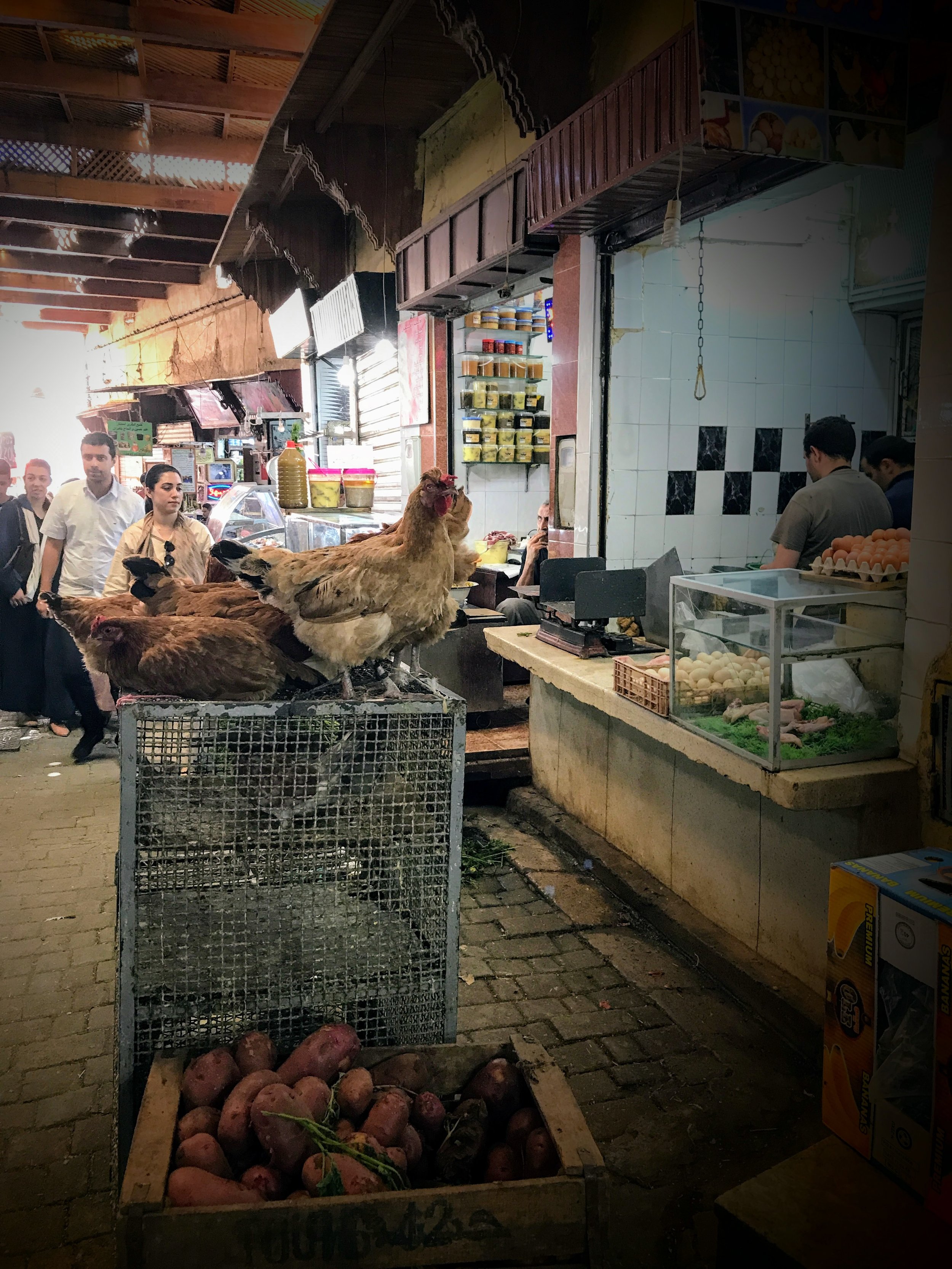
And the fifth kind is local-only-local food. People are selling live chickens and stuff like that that tourists aren't going to buy under any circumstances.
We do consume some of the first kind — expat tourist chow, because the space they provide is best for working (especially if they have roof-top tables where the WiFi reaches).
But our main diet is the fourth kind — locally owned food places mostly for locals. We're mainly on what I call the Medina Street Food Diet. Last night was a perfect example.
We spend most of the day at Cafe Clock, which is an ancient riad converted into a restaurant by some expats from Europe or America — not sure. We started out on the second level, but after a few hours it got hot so we moved to the rooftop. I drank coffee, and a little mint tea. We ate a little and worked a lot.

As the sun was setting, we headed back to our riad. We stopped at stall that sells awesome pickled veggies and olives, and grabbed a bag of each. They we found a guy with a bread cart, and picked up a Frisbee-size disc of Moroccan bread from him. In our riad, we had farmer's cheese we got the day prior from a guy with a stand at the entrance to the Medina. Plus we augmented this with olive oil we bought in Spain.
The aforementioned cheese guy let us try all the stuff he was selling. One was milk fermented in a glass. It's like kefir, but they add the milk to a glass (it has a liquidy custard-like texture but very mild flavor), and the glass sits there all day in the open, unrefrigerated. He also had a huge bucket of buttermilk, and you could see big chunks of butter floating in it. We tried it all and it was all delicious.
Other street vendors sell various sweets, covered in pastry dough, deep fried and drenched with honey or simple syrup. They keep these in big glass display cases, each of which may contain hundreds of wasps flying around and landing on the sweets. (We didn't have them because they're deep-fried.)
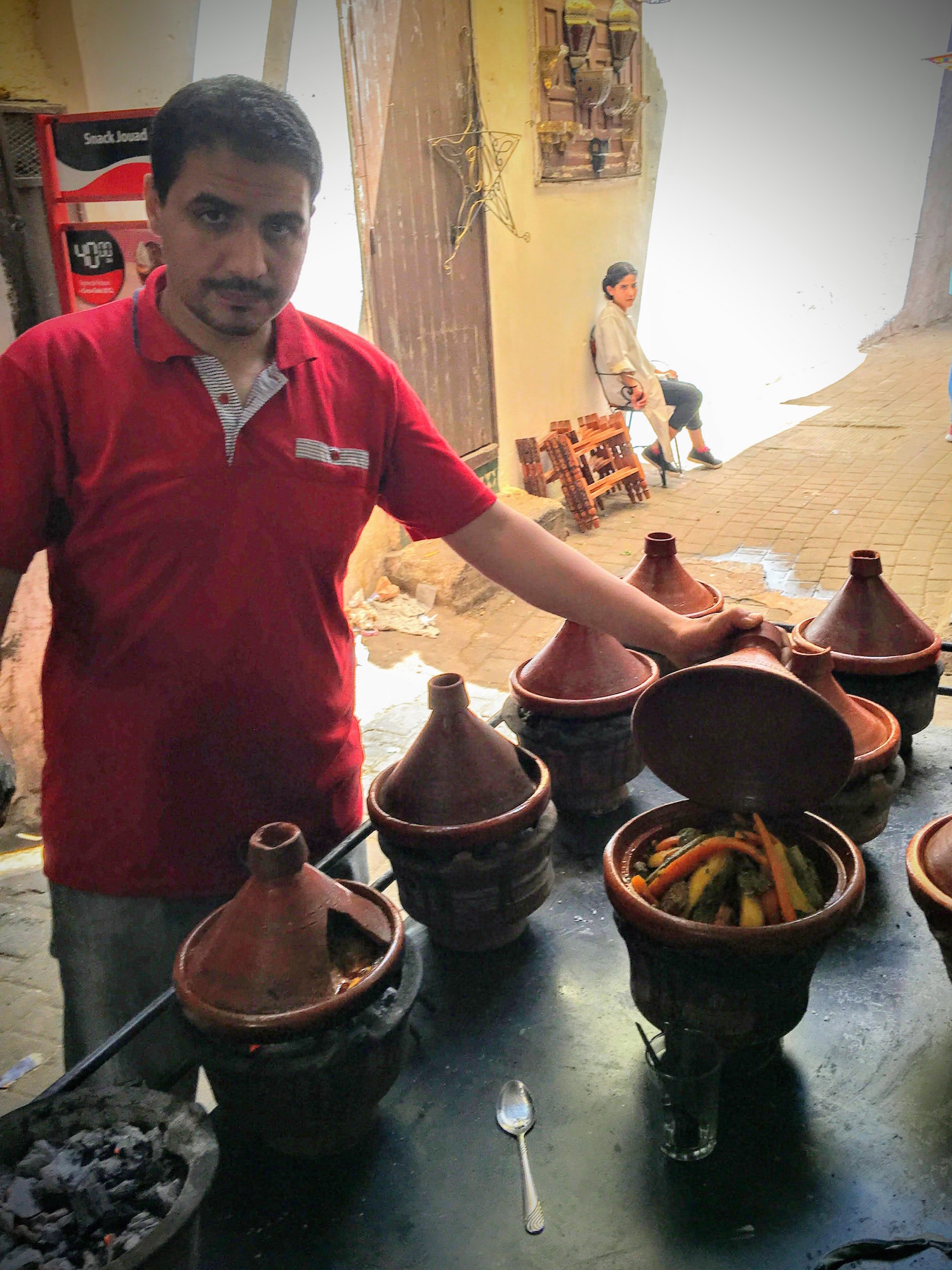
Another example was our lunch today. We were on our way through the Medina on our way to some WiFi, and spotted a big metal table full of tagines. The place looked totally legit, with an interior dining room with 100% of the customers were locals. So we asked for a tagine and a couple salads, and they brought it all, plus bread. We ate it with our hands local-style. It was delicious.
Americans are often freaked out by street food. The vendors are handling things with their bare hands. Refrigeration is non-existent. Things aren't covered.
My son, Kevin, has always been a reckless connoisseur of anything sold out of an outdoor cart. In recent years, I've come around to his point of view. In fact, when we were in Mexico City last year, I came to the realization how much I love street food that's aimed at locals.
I've gotten sick before while traveling. Once I got incredible gastrointestinal problems from coffee I bought from a Honduras gas station. I got super ill from Cuban Zika fumigation. But I never got sick from street food. Ever.
We're health nuts. Some Moroccan street food is unhealthy, and we avoid it. There's lots of fried stuff, and other foods are loaded with sugar. The bread is industrially leavened, as is the case with most of the bread in the world. (These are often modern versions of traditional foods that were baked instead of fried, sweetened with honey and dates instead of sugar and fermented with starter instead of yeast.
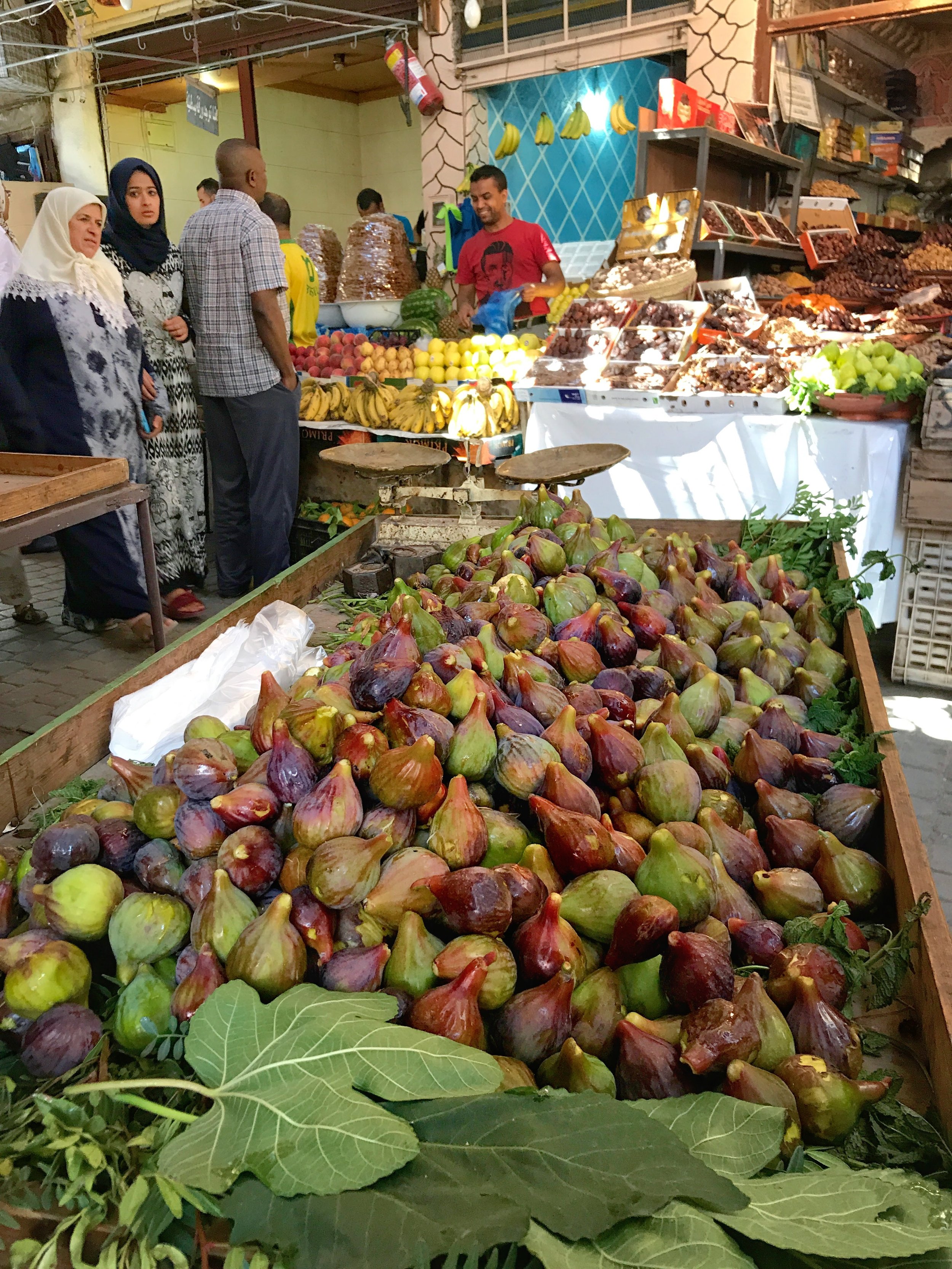
Other Moroccan street food is healthy, such as the range of fermented milk products, olives and other fermented and pickled vegetables, and of course natural produce, including dates, and we're living on that stuff, mostly. Lots of vendors sell soup, sandwiches and stuff like that. We do have bread but keep it limited in quantity (some foods like tagines and sandwiches really need the bread).
(Interestingly, most of the fermented milk and soups come in glasses or ceramic bowls — you stand there and have it, then hand the vessel back.)
The best stalls always have a crowd of locals clamoring to buy, and these places are worth the wait.
In any event, we're living mainly on the Medina Diet. (In fact, to a very large degree, we came here in order to be on the Medina Diet.)
Today it occurred to us that we have so much food to explore, and so little time.
Get our free email newsletter! (It takes 3 seconds to subscribe!)
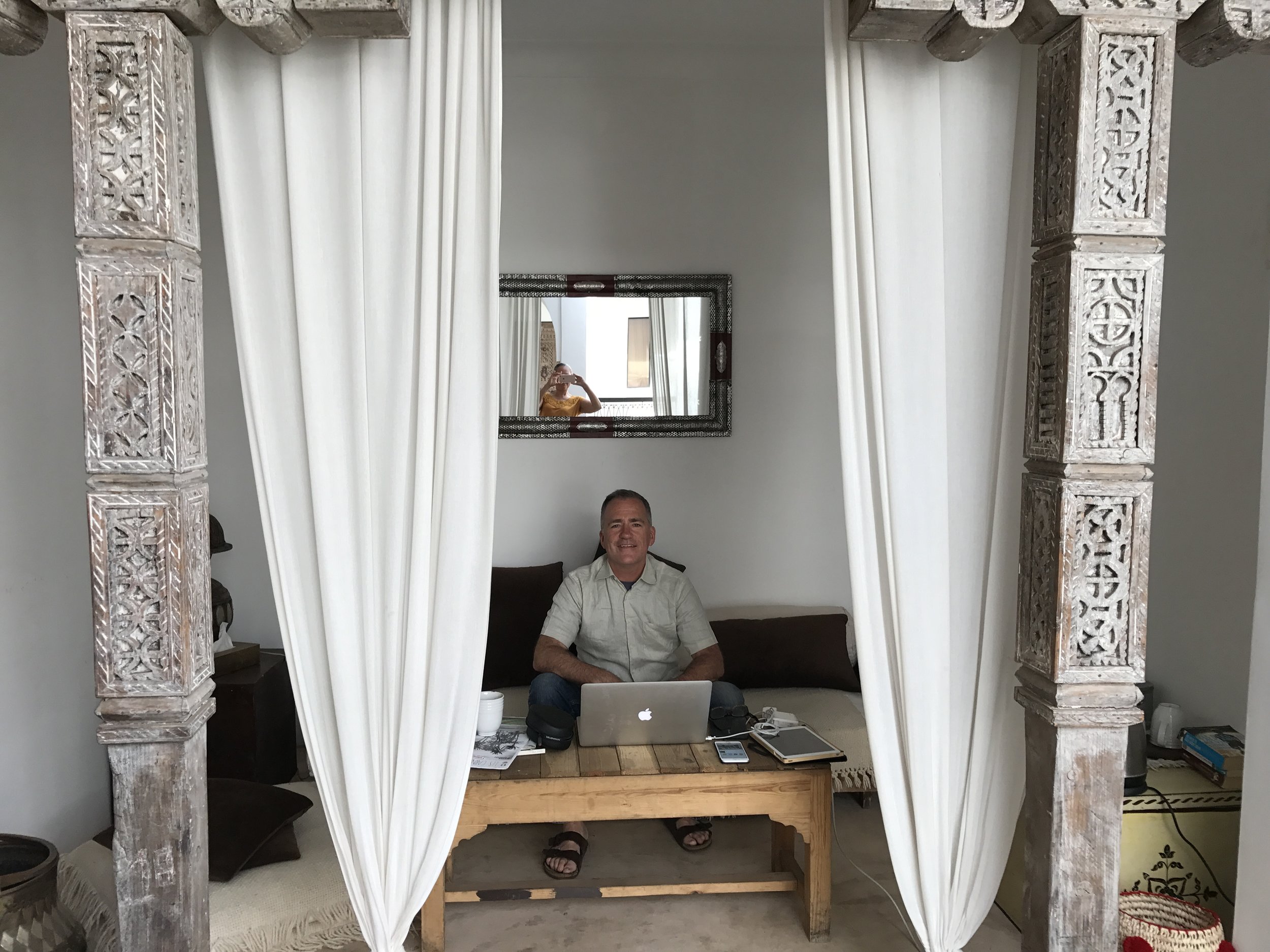
Wow, I love this riad! Beautiful rooms, awesome staff, great food.
Best of all, plentiful nooks and crannies like this for getting work done. This one, on the same floor as our room, has a handy outlet, great WiFi connectivity and an electric tea kettle where I can make my own coffee and tea.
This is the perfect place to work, I tell you.
Get our free email newsletter! (It takes 3 seconds to subscribe!)
#morocco #Marrakesh

After driving all day across some incredible desert landscapes and checking out a 300-year-old kasbah (fortified mud house), we arrived at our hotel, which has a balcony with a great view of the red citadel of Ait-Ben-Haddou.
Hollywood loves the citadel, that hill behind me. It appeared (with massive CGI upgrades) as the city of Yunkai in "Game of Thrones" and without enhancement in a couple dozen movies, including "Kundun," "Gladiator," "Alexander," "Kingdom of Heaven" and most importantly, "The Mummy."
Photos, videos, TV and movies usually show the other side — this is the backside.
This fortified village sat on the the medieval caravan route between the Sahara and Marrakech.
WiFi is slow, but there are outlets here and food, tea and coffee service from the hotel's restaurant. Plus the view. Overall, a great place to work.
Get our free email newsletter! (It takes 3 seconds to subscribe!)
One of the great joys of living in Spain is tapas culture. In its purest form, the enjoyment of tapas involves long evenings drinking slowly and talking rapidly. Each new round of beer or wine is accompanied by a small plate of delicious food traditionally chosen and paid for by the bar.
One joy about tapas: the element of surprise. No paralysis of choice. No buyer's remorse. You get what they give you. There's no menu. There’s no charge. It's wonderful.
Great tapas are one of the greatest food experiences you can enjoy.

Tapas are mostly an Andalusian thing. Outside Southern Spain, tapas often work differently.
Here's Barcelona's dirty little secret: Great tapas this town are hard to find.
There are two main reasons for bad tapas in Barcelona.
Many tapas restaurants list tapas on a menu, and charge for each dish individually. There's nothing wrong with that. In fact, it's a good thing, because it enables tapas to include more expensive ingredients and for the customer to be charged accordingly.
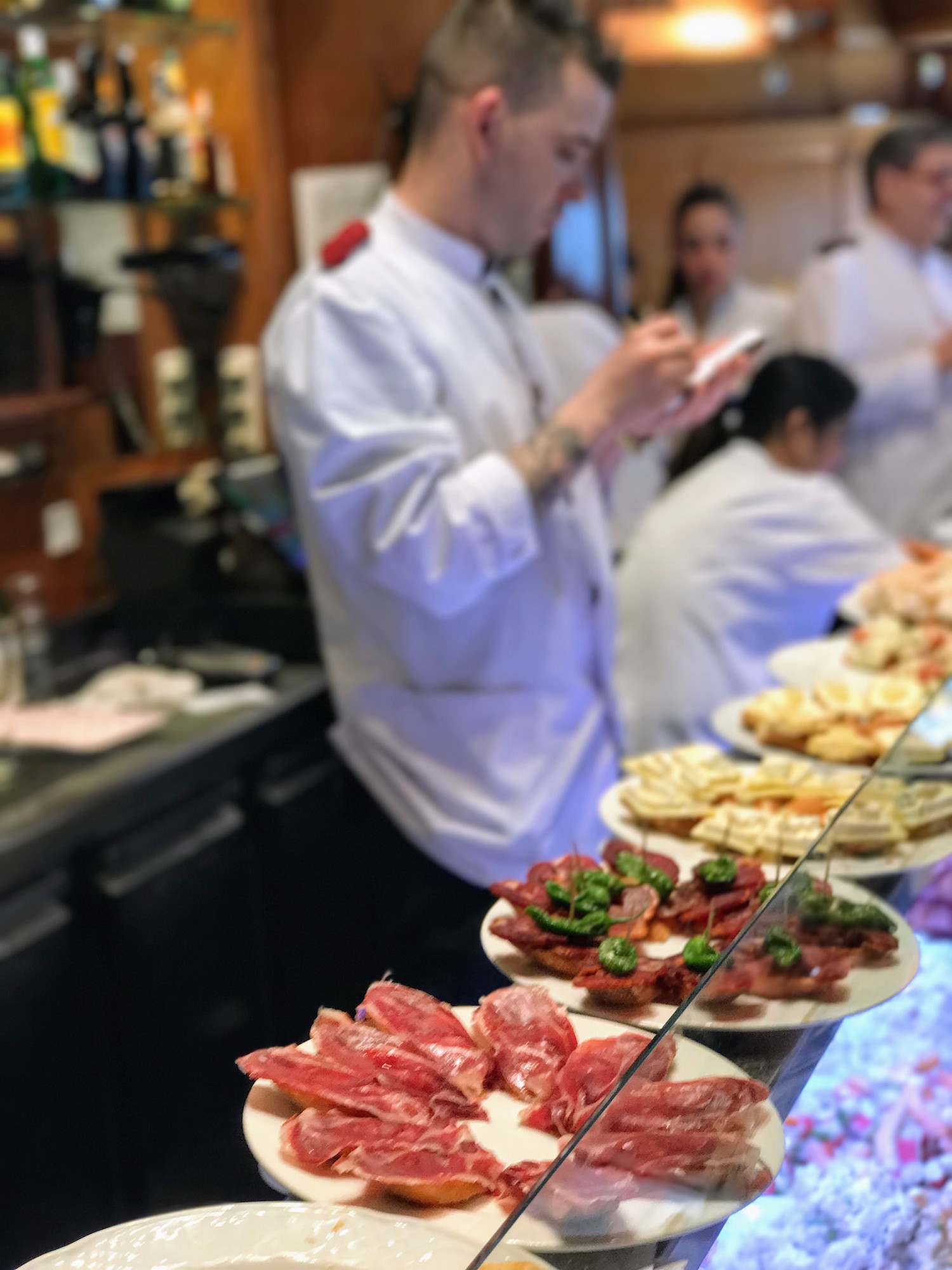
But most Barcelona tapas restaurants list their tapas on a permanent menu. And that's a problem.
Tapas tend to be best when they're assembled with ingredients of opportunity — seasonal produce, seafood that happens to be abundant in high quality on a random Tuesday, that sort of thing. Constructing an all-year, every-day menu means tapas bars will exclude seasonal ingredients and special ingredients.
There are ways around this, of course. Some tapas bars offer "specials" of the day or simply inform customers which items on the menu are unavailable.
The biggest problem with tapas, however, is when they're designed for tourists rather than locals.
Here in Barcelona, tapas bars are everywhere. Instead of tapas being made constantly and coming fresh out of the kitchen, they're often pre-made in large quantities, then displayed and stacked on plates on top of a counter top in a way visible to passers-by. Bars try to be more impressive by making large quantities and showing them off in large stacks.
Technically, these aren't tapas. They're called pinchos. And they're sort of like the Basque version of tapas. Unlike tapas, pinchos are not traditionally "free." You pay for them separately from drinks. Most pinchos involve something placed on top of a slice of bread with a single toothpick holding it all together. Sometimes they add up your "bill" by counting the toothpicks left behind.

A typical scenario on major tourist thoroughfares in Barcelona is a charming old-looking establishment that says "Tapas" on the outside, but with pinchos on the counter. That's the winning combination. The reason is that tourist are more familiar with the word "tapas" but pinchos are stackable and impressive.
In the tourist places, these stacks of pinchos often sit there for hours. The bread is getting soggy and stale simultaneously. Grime and dust from the city are coating them. Making matters worse, items are designed to survive this ordeal and still look vaguely edible by the time they eventually reach somebody's mouth. So they tend toward big slabs of meat or fish, and entire categories of tapas and pinchos are eliminated.
In other words, when you're targeting tourists, tapas don't have to taste good. They don't even have to be tapas. They have only to look good. So all effort is focused on the appearance and ingredients, food handling and other aspects suffer. Tourists aren't going to become regulars anyway, so no harm done to the business if the food sucks. (In real tapas culture, each bar is in a contest with the other bars for the affection of regulars.)

Another problem is that Spaniards like to close their shops for siesta, national and local holidays, and for family time when the kids are out of school. In a tourist-intensive city like Barcelona, non-Spanish tapas bar owners (immigrants from Asia or the Middle East, mostly) have an advantage. They stay open during siesta and holidays, and can thereby make a lot more money — enough to pay inflated building rents in heavily trafficked areas.
All this results in the proliferation of tapas bars in tourist areas that aren't owned by Spanish people, aren't coming from tapas culture and don't have good tapas and they advertise with mishandled pinchos. These bars are a simulacrum of real tapas bars, but the tourists keep them in business.
Tapas and pinchos are like pizza. Even when they're bad, they're still pretty good. And when they're good, they're spectacular.
The good news is that incredibly great tapas and pinchos bars do exist in Barcelona, and we have found them all.
During our Barcelona Experience 2017, we're not going anywhere near tourist tapas. We're going straight to the best tapas made with high quality and seasonal ingredients that are fresh and made to order. And, of course, we’ll enjoy some freshly made pinchos, too! Come and experience the real Barcelona with us and the best bar food this beautiful city has to offer.
There's nothing in this whole world like great tapas and pinchos in an authentic or visionary bar in Barcelona. You simply MUST experience this.
Get our free email newsletter! (It takes 3 seconds to subscribe!)
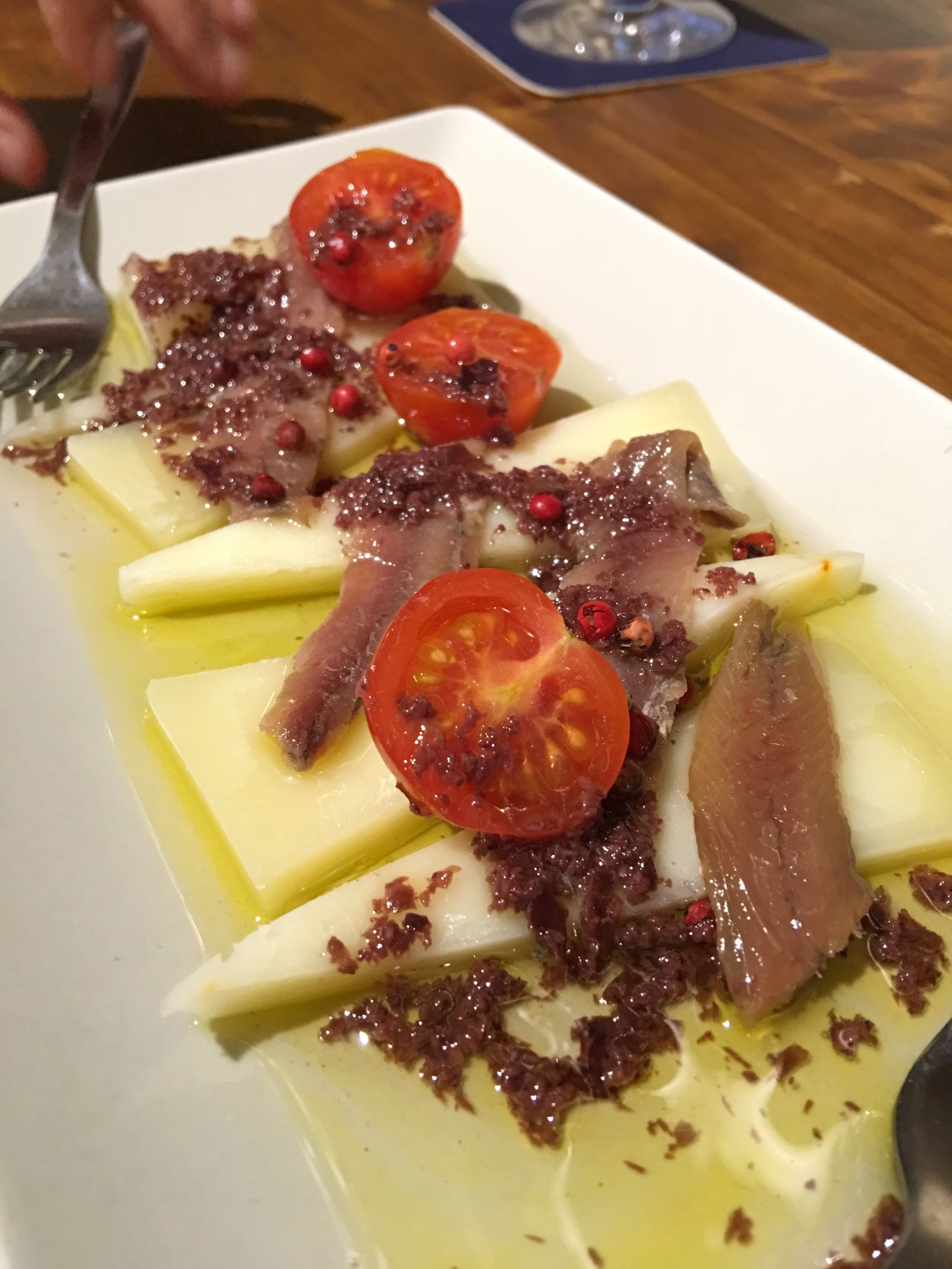
I love me some tapas. And, of course Spain is tapa heaven.
So far, my favorite tapas came in the form of manchego cheese topped with anchovies, mashed olives, peppercorns and cherry tomatoes, then drizzled with olive oil.
So. Fricken. Delicious.
(Join us for our Barcelona Experience 2017! We're definitely having this!!)
Get our free email newsletter! (It takes 3 seconds to subscribe!)

This is a nice little cafe that has great beer made in-house and a seat in the window.
Join us in Barcelona in September!
Get our free email newsletter! (It takes 3 seconds to subscribe!)

One advantage of nomadic living over tourism is that you can make the time to discover more.
We're here in Barcelona, and Amira is preparing for our Barcelona Experience 2017 event. Those preparations are both systematic and unsystematic.
The systematic planning involves countless hours researching, and also grilling friends and contacts in the city in search of Barcelona's most amazing food experiences. We then go there, meet people, try things and learn more.
The unsystematic approach involves walking around. This is my favorite kind, and we did this for about 8 hours yesterday. During this time, Amira had mapped out six or seven food places (restaurants, bars) and we checked them out. En route, we explored every interesting thing along the way. Sometimes a discovery leads to another which leads to another — for example, you find an amazing restaurant serving amazing bread. Then we find out where the bakery is, check it out, and learn about a new food visionary bakery doing amazing things. We get to know the baker, who introduces us to an amazing wine-maker we otherwise would never have discovered. Etc. Which is... amazing.
We've been doing this for years in Barcelona, having lived here several times for many months each time.
In any event, this wandering around process takes months in any given city. It's a lot of fun. But it's time consuming.
By the way, we still have spots open for The Barcelona Experience 2017! Join us!
Get our free email newsletter! (It takes 3 seconds to subscribe!)
In our search for Catalonia's greatest food secrets, we've had to look beneath the surface. Literally!
Our quest took us to the cava-producing region near Barcelona. As with Italy's prosecco-growing area, the places where cava is produced is mind-blowingly beautiful, with rolling hills of vineyards, ancient farm houses and tiny villages, each wrapped around a medieval church. (The region is also dotted with bunkers and other painful reminders of the Spanish Civil War.)

A few decades ago, every sparkling wine was called "champagne." But Champagne is a wine-growing region of France. With the rise of the EU, French producers were able to ban the use of "champagne" for any sparkling wine produced outside the area. (You can still see wine buildings in Spain that say in faded paint "champán," the Spanish spelling of "champagne.")
In response, California producers in all their utilitarian artlessness started calling it "sparkling wine." Italians renamed it "prosecco," after the village where the glera grape may have first been developed. And Spain called it "cava."

Cava, it turns out, is Latin for "caves" — the place where grape juice is transformed, and later where bottles are stored for aging. And, boy, are there a lot of caves in cava country.
Anywhere you go in this part of Spain, you encounter cava-producing wineries — buildings of various sizes, with the largest producers centering around building complexes that are larger than most of the towns in the area.

Beneath all these producers are deep caves where the wine is aged. In many cases, they're not stored in containers, but in tiled "rooms" whose sole purpose is to gain hundreds of gallons of cava.
Bottled cava is even stored in Civil War bomb shelters, the brick entrances of which pop up randomly in vineyards.

These wine "caves" also serve as ready-made cheese aging facilities. With a little tweaking and air management, the temperature and humidity can be maintained perfectly, even in Spain's blistering-hot summers.
Our upcoming Barcelona Experience 2017 will take us to the cava country, where we'll explore the beauty of this place, introduce you to the region's visionary food and wine makers — and also marvel at what's taking place beneath the surface.
Get our free email newsletter! (It takes 3 seconds to subscribe!)

This is a classic photo of one of the typical fruit stands at La Boqueria Market.
What is La Boqueria? To me, it's the heart and epicenter of this glorious city of Barcelona, Spain.
Carefully and beautifully arranged fruit in a display of colorful art to entice the senses of even the most jaded market visitor, this is La Boqueria's signature.
I take this shot every time I come to Barcelona, in fact. It's one of the many familiar places in this wonderland of Farmer's markets.
La Boqueria isn't really a farmer's market. You won't find many real farmer's there. (The true farmer's market actually set ups in the mornings right next to La Boqueria. It's tiny, but everything's cheaper.)
There are many markets in Barcelona. In my experience, most tourists don't bother much with the other markets.
We were last here in Barcelona two years ago, which might be the longest period of time we've gone without visiting this awesome city. It's been a culture shock to see how much more crowded it is now than ever before, and it's not even peak season yet. I have never seen Barcelona, La Rambla and La Boqueria so completely packed and overrun by tourists. I get it, we all love this beautiful city so much. But the Barcelona I first visited has grown and changed enormously.
Our love affair with Barcelona goes back three decades. Mike and I first visited and fell in love with Barcelona when we spent a week here for our honeymoon in July 2007 (we also went to Italy and France). We had the most amazing time and while we had more sangria than should ever be allowed, I still remember all the magic of the city very clearly.
We want to re-capture that magic and share it with you. That's why we've launched Gastronomad Experiences!
Naturally, for our very first of these experiences, and to commemorate our love of food, wine, travel and adventure, we had to choose Barcelona!
We're here in Barcelona for one month to finalize the details of this extraordinary event (which takes place in early September. Click here for details.)
We created these experiences with you in mind. As we've had our amazing adventures abroad and find ourselves having the incredibly magical times and epic experiences, we've always wanted to be able to transport you to our table for you to share the joy with us. And creating our Gastronomad Experiences is a wish come true for us.
Mike and I try to do that everyday. It's a work in progress but the more you practice it the better you get at it. We strive to make life fulfilling, meaningful, rewarding, fun, adventurous, and joyous.
The Barcelona Experience will happen only once! (We'll never repeat an Experience.)
We'll enjoy tapas of the highest order with true local chefs. We'll experience the true bohemian side of this city. We'll learn the secrets of Catalonian cuisine. We'll explore the musical rhythms of flamenco. We'll talk to cultural experts to enlightened us about all things Catalonia and among other things, we'll be visiting the true countryside of Barcelona for a proper wine country day! We'll visit wineries and make wine!
Let's live it up together!
If you're interested in joining us — or just finding out more — send us an email from this page. I'm looking forward to hearing from you! I hope you can join us! -Amira
Get our free email newsletter! (It takes 3 seconds to subscribe!)
Amira and I spent nine days in the prosecco-growing region of Italy doing our early preparation for a Gastronomad Experience next year (sign up for the newsletter to get updates).

During this trip we've explored dozens of food producers, farms, markets and, of course, wineries. We've tasted and sampled and explored our way through this breathtakingly beautiful corner of the world in Northern Italy near the Austrian border, and found some of the area's greatest food visionaries for our Prosecco Experience 2018. (It's hard work, but somebody's gotta do it.)

In recent years, the world has fallen in love with prosecco. Demand is soaring. So the region struggles to increase supply. A region once balanced in crops and livestock has been almost entirely converted over to the growing of Glera grapes, as well as other secondary grapes that can be added to prosecco. And growing for prosecco has spilled out of the hills and onto what I call the "Prosecco Plains."

In short, there are a lot of newcomers growing grapes to make prosecco. We encountered many of these winemakers, young, old, big, small and everything in between. We've made some great friends and found the region's most visionary food and wine people.
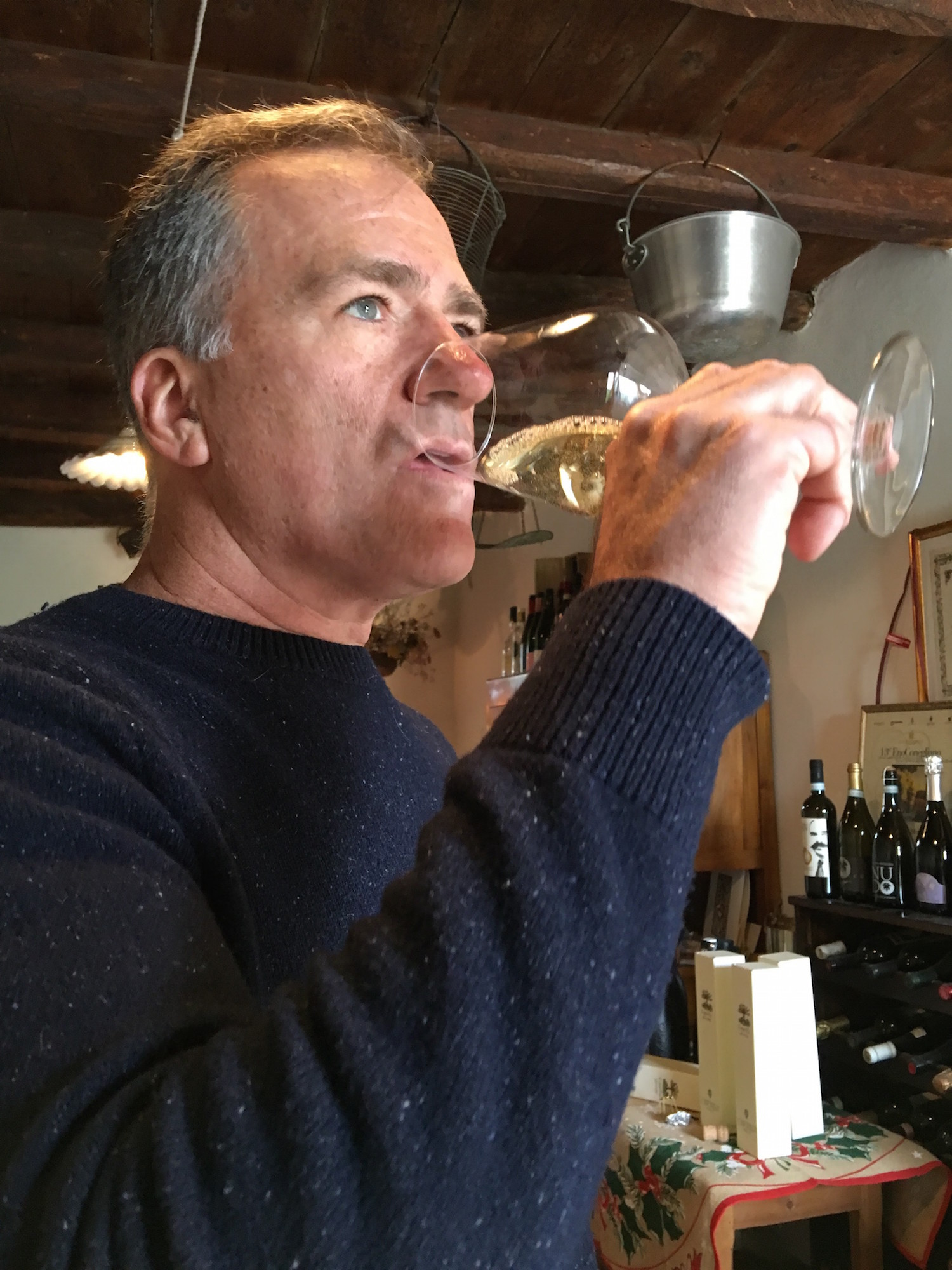
Some of our favorite wine-makers were the traditionalists in the traditional growing areas.
Of course, talking about wine is pointless. You've just gotta try it.

We'll definitely be drinking the best proseccos in the world during next year's Prosecco Experience — plus some amazing food! Sign up for our email newsletter to stay up to date about this event!)
- Mike
Get our free email newsletter! (It takes 3 seconds to subscribe!)

We were super excited to have an Easter meal at a great restaurant specializing in the region's traditional staple of spiedo, which is fire-roasted meat of just about any kind served with polenta.
The Mayor chose the restaurant for us, so we didn't know what to expect. It's called Baita alle Grotte.
We arrived on schedule and inside were a few very large tables seating between 10 or 20 people -- obviously local families dressed up and enjoying a traditional holiday meal. We had the only small table, and the only available one.
It turned out to have been a seven-course meal, with several of the courses including multiple options, and it took us four hours to get through it. Every. Single. Thing. Was absolutely delicious, authentic and amazing.
(We're planning our Prosecco Experience 2017 — sign up for our free email newsletter here to stay up to date on what will definitely be a spectacularly delicious adventure!!)
Here's our incredible, unforgettable Pasqua (Easter) dinner in Cison di Valmarino.

Piccolo sformatino all' apsarago bianco di Cimadolmo cnelle all'uovo e tartare di zucchine.

Punta di vitello arrosto su piccola misticanza profumata di primavera glassa balsamica.

La tortiera ai carciofi con rosellini di sopressa e la giardiniera sottolio.

Il timballo paglia e fieno al ragu delicato d'agnello e vitello.
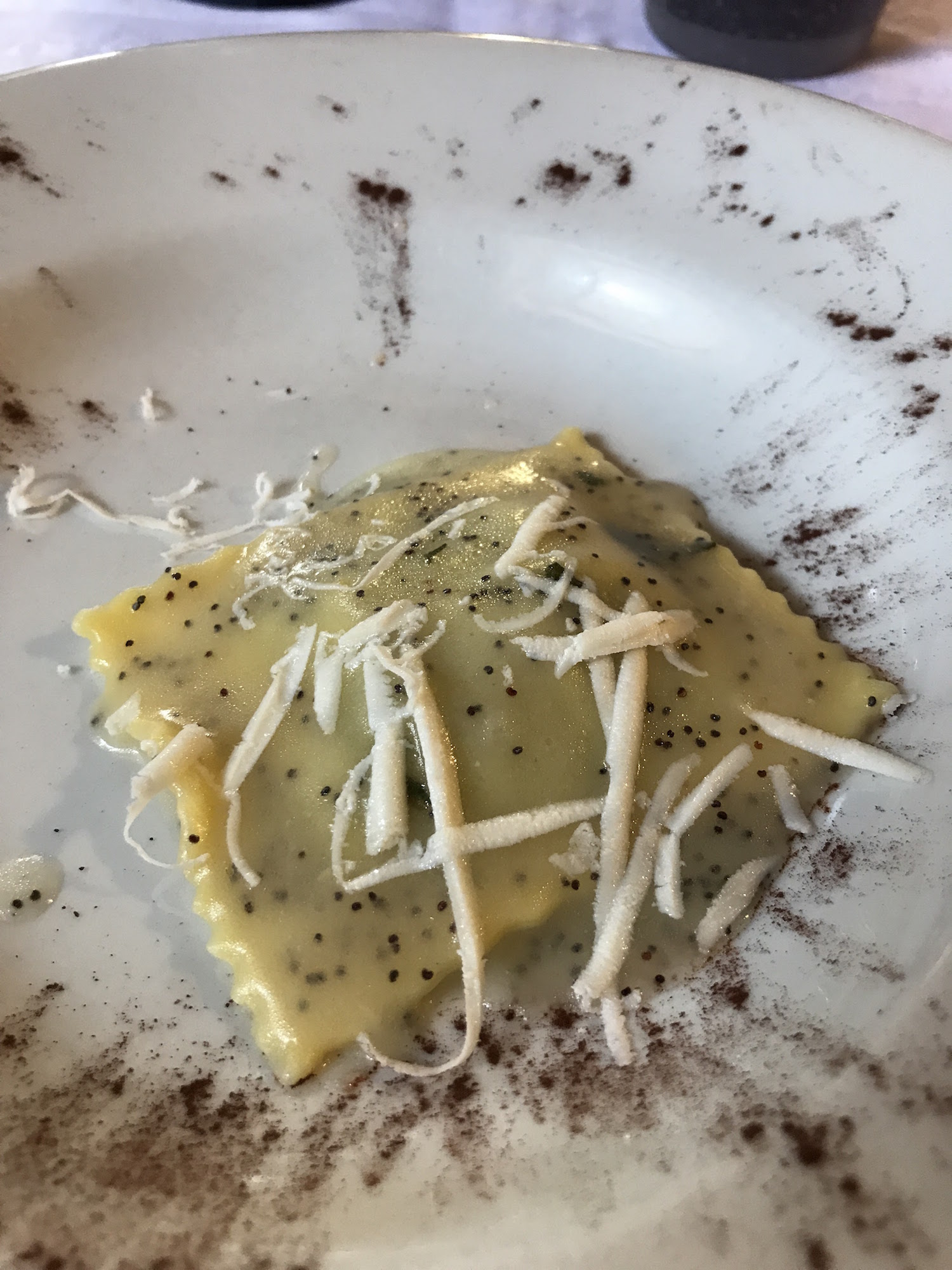
Il raviolone alle erbette spontanee burro, salvia, papavero e la ricotta salata.
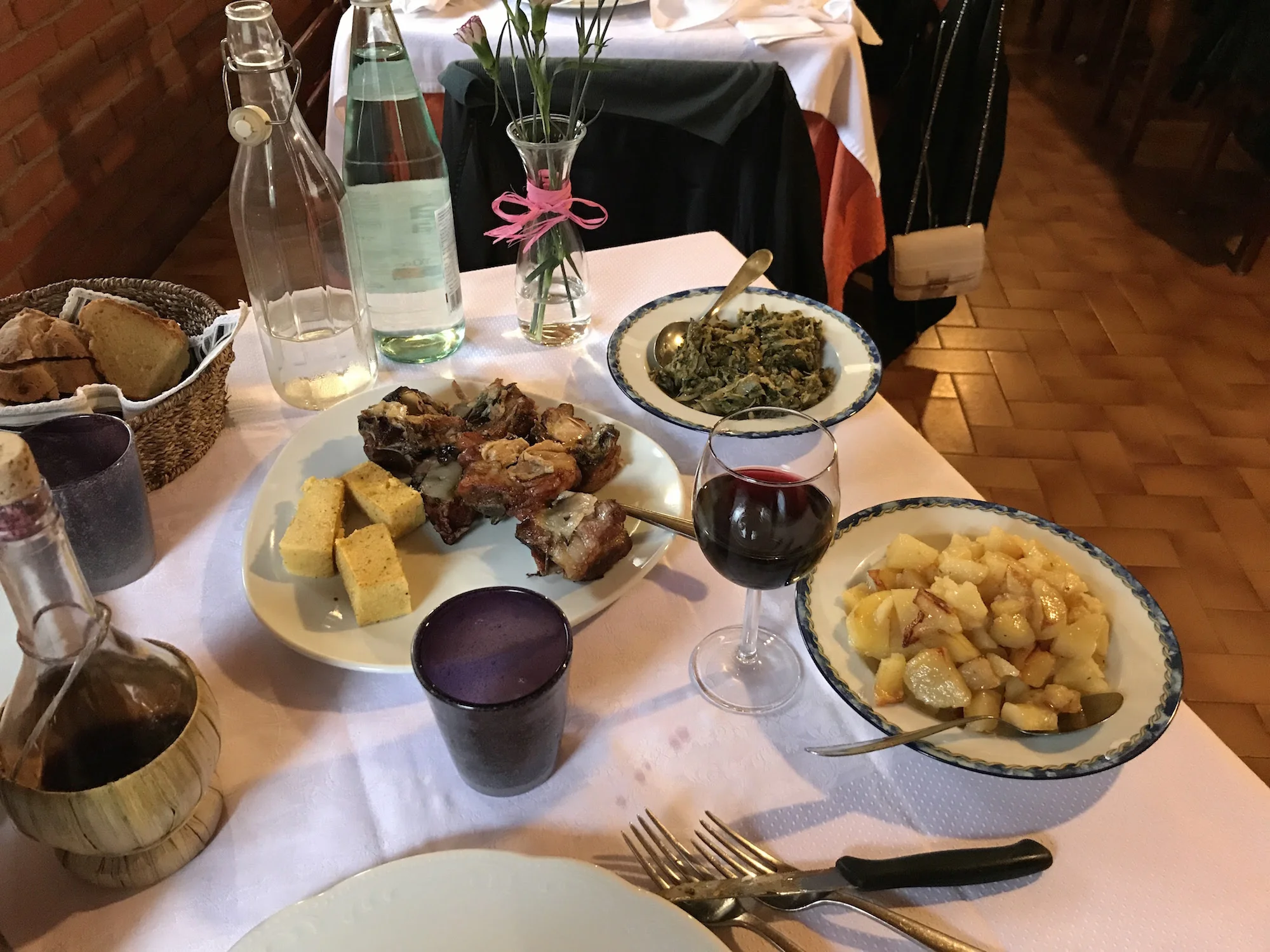
L'agnello, le costicine di maiale e pollo ruspante allo spiedo con polenta.

(Same course as above, but plated.)

Fantasia di frutta col gelato alla vanglia e granella croccante.

The waitress came around with several kinds of house-made grappa served in our coffee cups.
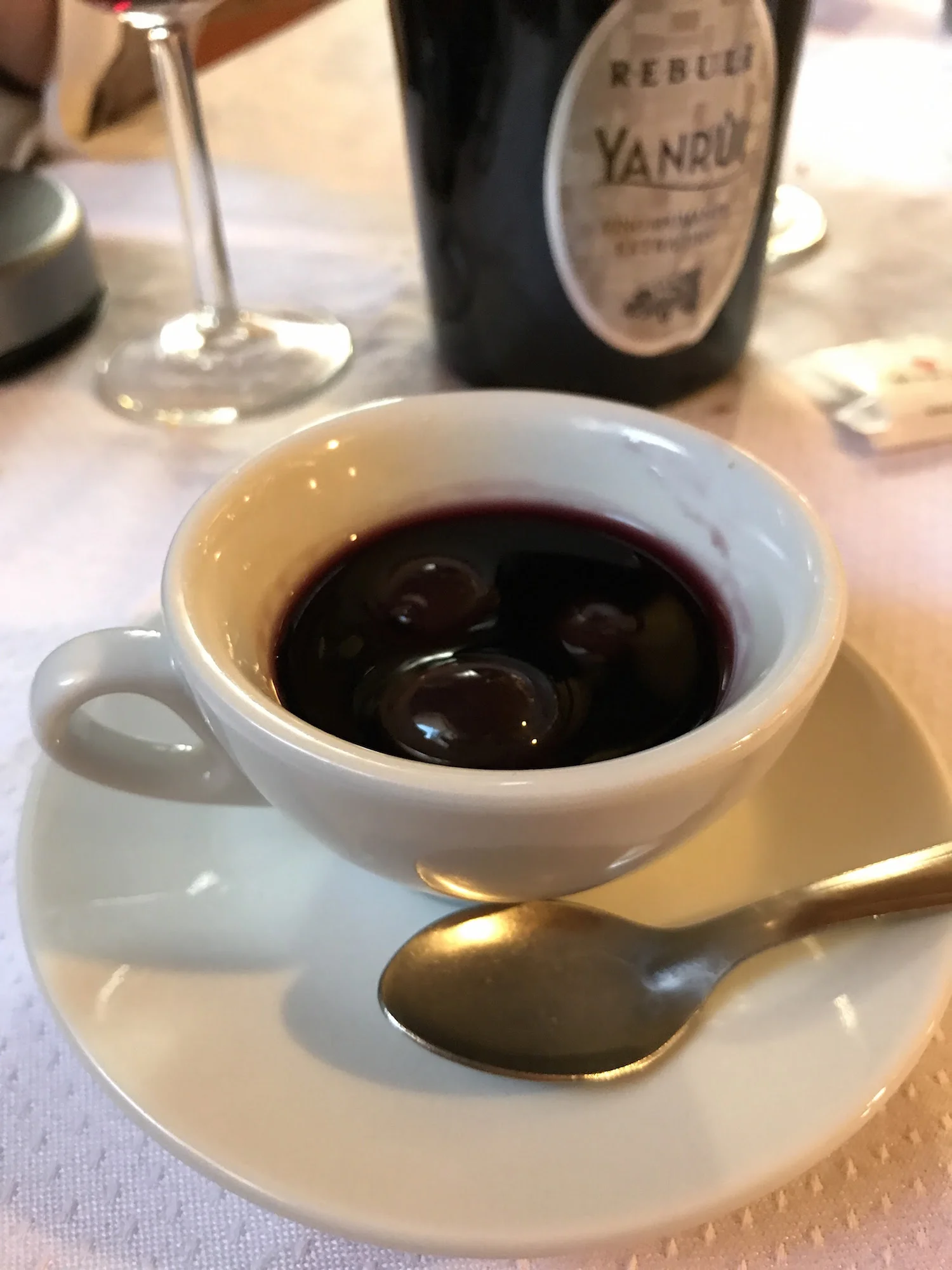
Cherry grappa. Wow!
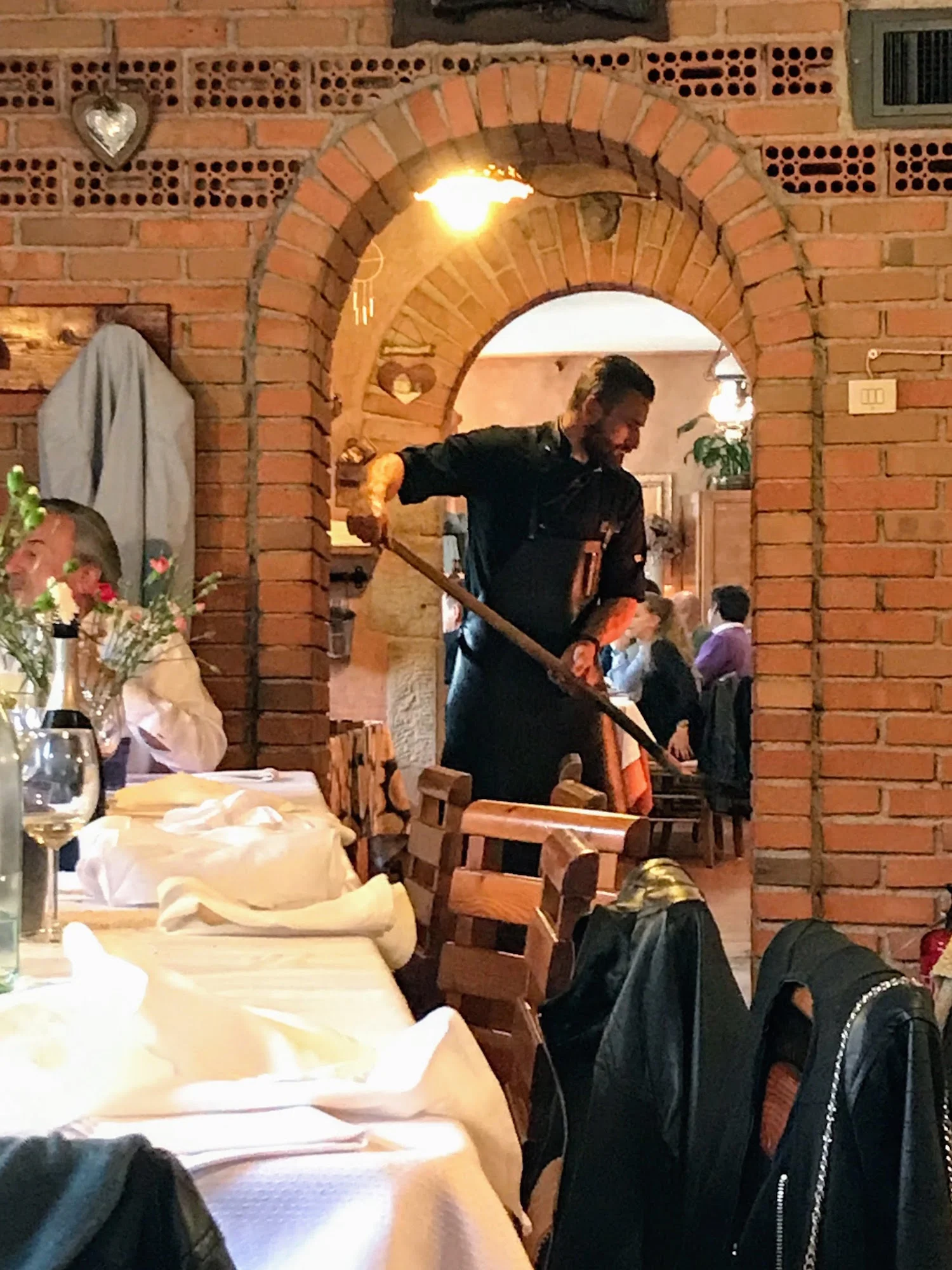
This was an unforgettable experience.

The Americans closed the joint.
Get our free email newsletter! (It takes 3 seconds to subscribe!)
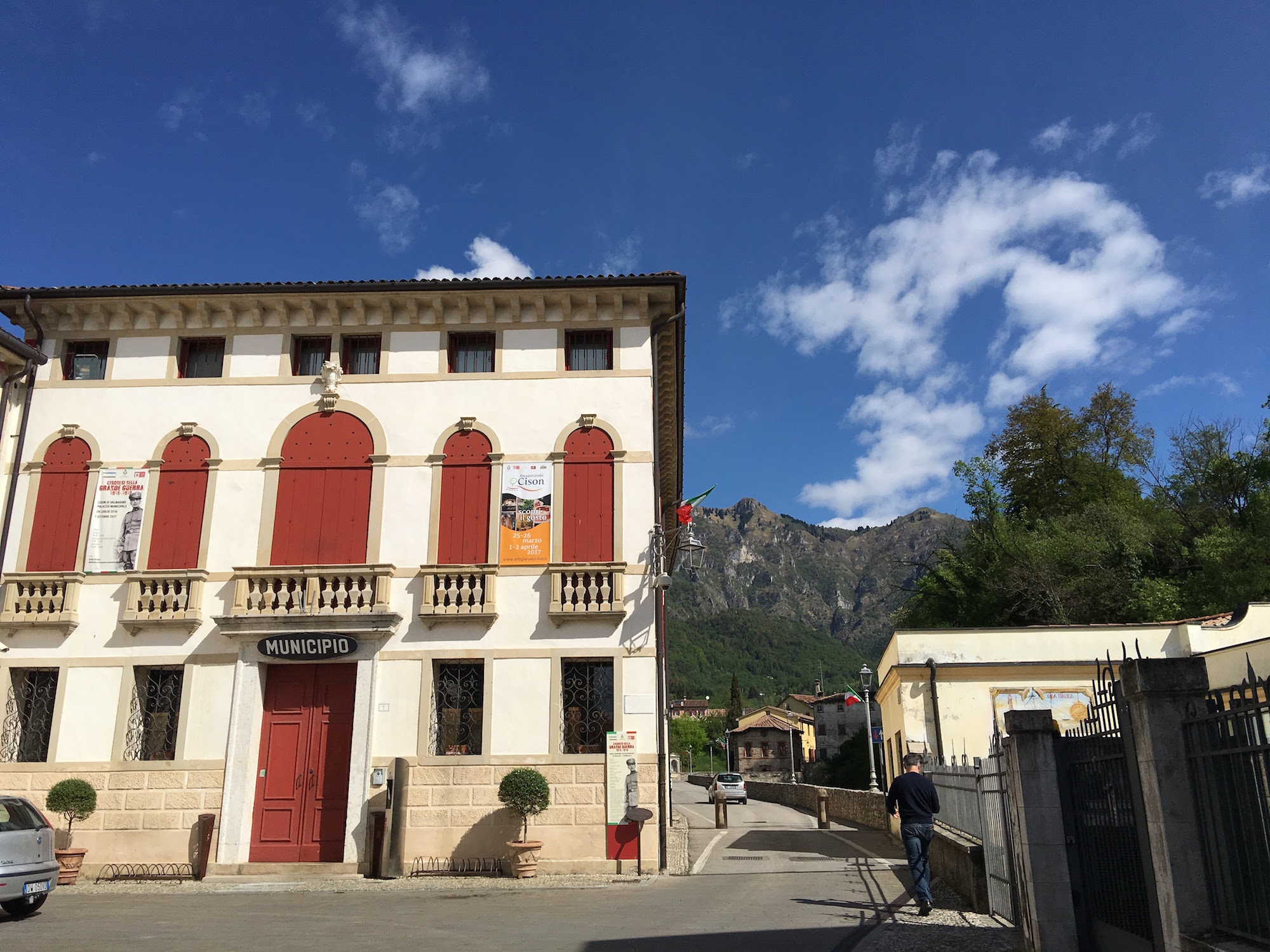
The ancient town hall building of Cison di Valmarino.
The day before Easter we rolled into the spectacularly beautiful village of Cison di Valmarino, which is in the Prosecco-growing region of Italy and very close to Austria.
After checking into our AirBnB, our host told us that the Mayor (the real mayor, not the one on Foursquare) would like to meet us and sit down for coffee, and asked if we were available the next morning (Easter Morning). We said yes, and she said she would tell the mayor.
We then set out to find survival provisions (wine, bread, cheese, fruit, chocolate, etc.) as we were told that on Easter and the day after all stores would be closed and all restaurants booked; if we didn't have a reservation by now, we would not be eating at a restaurant. We found a small mom and pop mini mart place (well, pop anyway -- no sign of mom) and loaded up on foodstuffs.
So at the appointed hour next day our host arrived to convey us to the town square around the corner.

As we walked into the square, the mayor, whose name is Cristina Pin, drove up, got out and said hi (in Italian -- she didn't speak much English, so our host did the translating).
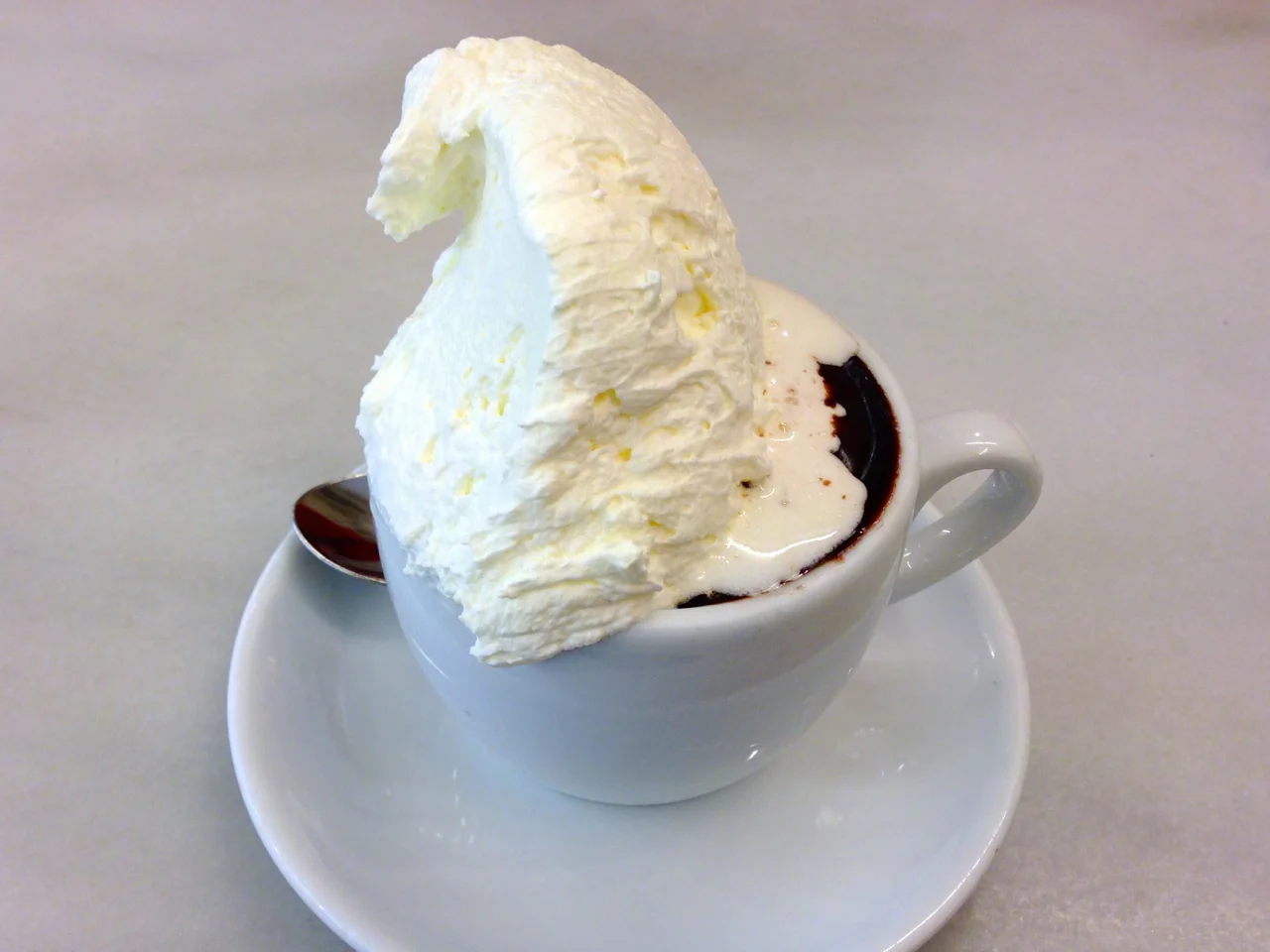
She invited us in to a really charming cafe, where there was a cozy nook in the back where we had some very good coffee, hot chocolate, croissants and pastries and talked about the town and also about our Gastronomad Experiences. (She thought it sounded like a good idea to have one in the Town next year.)
The mayor then gave us a tour of the town hall, dates back to the 16th Century. The building is absolutely amazing, and retains ancient terrazzo tiles on the floor, rough beams carved centuries ago with an axe and other original features. But in offices and meeting rooms, most of the furniture is modern.
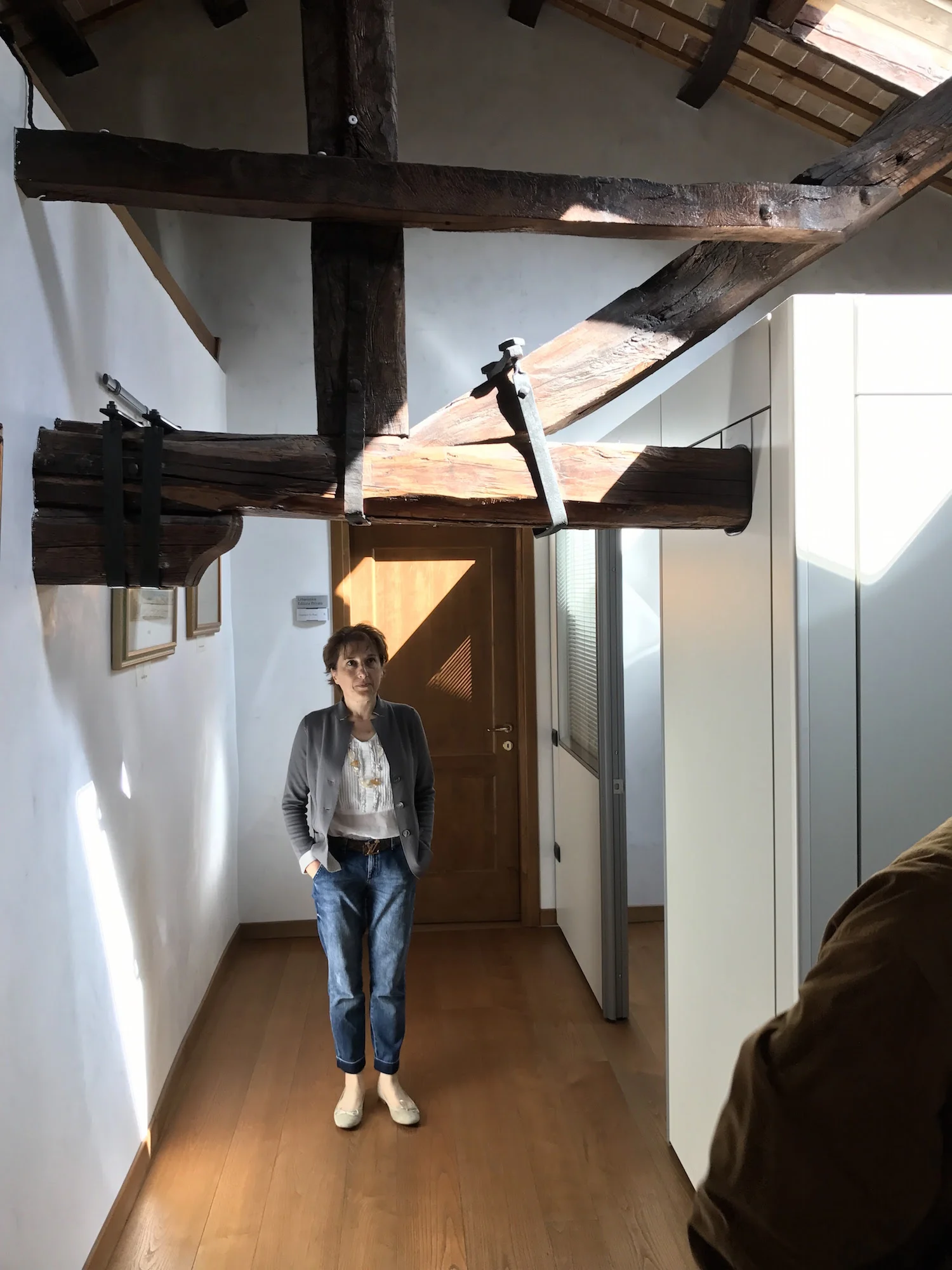
Mayor Cristina Pin
While we were in Mayor Pin's offices, we mentioned that we were looking forward to trying the local specialty, which is basically meat roasted on a skewer over a wood fire and usually eaten with polenta. She asked where we planned to eat that night, and we said we had no reservations. So she whipped out her phone, called a restaurant and made us a reservation. (No way they had availability; I wonder who they bumped.)

The Mayor gave us two books related to local history, which she signed, and rushed off to the church for Easter services.
(We're planning our Prosecco Experience 2017 — sign up for our free email newsletter here to stay up to date on what will definitely be a spectacularly delicious adventure!!)
Get our free email newsletter! (It takes 3 seconds to subscribe!)

Amira found and rented this wonderful 17th-Century house in the middle of endless northern Italian vineyards that will yield prosecco. What a wonderful place to work.
Get our free email newsletter! (It takes 3 seconds to subscribe!)


We enjoyed a very nice sunset dinner tonight at a restaurant here in Venice called Pizzeria Oke. We got to sit right by the water. We ordered a better-than-average aperol, and a spectacular beer made here in Venice (called Redentor), as well as a plate of seafood and a really nice pizza.
The seafood plate was amazing. (Venice has some incredibly fresh and delicious seafood.) This dish included fresh sardines, a baby octopus, squid, cod, salmon and a breaded and deep-fried something or other that was very good.
After dinner we made our way back to our apartment, a process that involves general movement in the right direction, with a lot of dead-ends in painfully charming alleys (often terminating in a canal).
Venice is wonderful.
Get our free email newsletter! (It takes 3 seconds to subscribe!)

A friend recently asked me: "How do you find the best places?"
In fact, people have been asking both me and Amira this question for years. We've been sharing our foodie experiences on social media for the last ten years, and our friends and followers are often shocked by what we're able to discover and experience.
And it's more relevant than ever, now that we're inviting small groups of friends to join us for Gastronomad Experiences. (Our next three Experiences are in Barcelona, Fez and Mexico City.)
The answer to how we find the best places may surprise you.
Our discovery process has three components: 1) Time; 2) Investigation; and 3) Context.
1. Time
The time element is key. We find that it takes weeks or months of full-time exploration to truly discover cultural traditions and the real food scene in any city as well as those cities where the best food is found. This exploration is informed by weeks or months of research online and by phone, followed by additional weeks or months of research on the ground at each location. Amira does most of this work, and she spends a great deal of her time on this.
For example, in a couple weeks, we're headed to Europe to do advanced recon on a very special location for next year (to be announced).
Then, we're moving to Barcelona for a month where Amira will complete her research and outreach for the upcoming Barcelona Experience (even though we've lived in Barcelona several times).
After that (though we’ve travelled to Morocco several times), we're headed to Morocco for two full months of research and exploration for the upcoming Morocco Experience.
Because we, ourselves, are gastronomads, we have the time to conduct deep exploration of each city before events.
2. Investigation
We discover places through two basic processes. The first is that we cultivate serendipity.
We love to walk for exercise, and typically put in between three to ten miles per day. We systematically meander through a city's streets and alleys and boulevards, always on the lookout for undiscovered gems to explore.
The second process is investigation. Amira spends hours each day working like a detective or private eye or shoe-leather investigative journalist. She starts with a market or shop that looks high quality, grilling them about all aspects of their operation and philosophy, and also asking them about suppliers, traditional artisans, makers and farmers and food visionaries in the area. She then takes what she's learned to the next person, and continues this way through the city's high-quality food sector.
Over the weeks, she figures out who the real innovators and traditionalists are, who's offering what, and where the special farmers, vineyards, wineries, breweries, butchers, cheesemakers and restaurateurs are. She gets to the root of what drives the food scene in that town. We try and test and sample -- this is where I come in. (Hey, somebody's gotta do it!)
3. Context
Amira doesn't approach all this from a vacuum. She's spent her entire adult life as a food professional, beginning her career with heading food and beverage operations at prestigious hotels (Mondrian, Beverly Wilshire, Westin Bonaventure in Los Angeles and Park Hotels in New York City). She’s also worked as the special events executive catering manager for the chancellor of UCSB, has her own practice providing health counseling and food counseling work and has been a lifelong creative force in the development of healthy, organic recipes and cooking methods. (Check out her amazing creations on Google+.)
In short, we discover the best food places with a lot of time and work pursuing our lifelong passions, and it's a joy to do.
Get our free email newsletter! (It takes 3 seconds to subscribe!)
If you've followed us on social media, then you know that we consider the combining of work and play something of an art form.
We've always have told readers that we'd love to share our amazing meals, exquisite scenery and epic experiences as we travel the world. So now we're doing it!
We carefully select the most spectacular locations in our favorite cities, then host a small group of fun-loving foodies for a few epic days and nights to deeply explore the local food and drinks culture with experts in every field. We'll cook, explore each city's best secret food spots, markets, bars, wineries, history, culture and more. (Plus, we'll throw in some optional professional courses along the way.)
It's a nothing like a conventional packaged tour -- each event is a real and uniquely handcrafted, once-in-a-lifetime experience curated by Amira and me to reflect the way we live -- like "temporary locals."
We find secrets places and hidden gems that mainstream tourists don't know about. We connect with the locals and explore culture and culinary traditions that most travelers would never discover or know to do on their own.
Get the details on our Experiences page!
Our first event is: The Barcelona Experience. This exclusive, 5-night, 6-day experience is a celebration of life, Catalonian style! Get more information and apply here!
Our next one is: The Morocco Experience, which takes place in Fez, Morocco, at the end of September. Click here to get on the list for Morocco!
Get our free email newsletter! (It takes 3 seconds to subscribe!)

I had an amazing time in Cuba. It wasn't a vacation. I was working the whole time. So I needed to keep all my stuff charged. But the thing about places like Cuba is: So much sunshine; so few outlets to charge my phone, tablet and laptop. They don't have a Starbucks on every corner -- or any corner.
I can't tell you how many times I've found myself in some random country unable to charge my phone. Where do you do it?
Meanwhile, the sun is often beating down -- the sun, of course, is what Elon Musk called "that big fusion power plant in the sky."
The obvious solution is some way to charge using solar power.
Fortunately, I was using an eval unit of a really great product called the Solartab Solar Charger. It's a BAB (big-ass battery -- 9,000 mAh, actually) that can be charged by plugging it into an outlet -- or by exposing its solar panels to the sun.
I can charge anything that plugs in with USB (like my iPhone) or USB-C (like my Nexus 5x).
The truth is that I normally charge it in the wall, not the sun. But because I have the solar option, I never have to worry about running out of juice. And I really have needed it a few times.
Carrying the Solartab is just like carrying a tablet. It's got a cover, which can be used to prop it up to optimize the angle toward the sun. It's also rugged and waterproof, so you don't have to baby it when you're hiking or sailing.
Here's all the gear I use and recommend.
#solar #solarpower #solartab
Get our free email newsletter! (It takes 3 seconds to subscribe!)
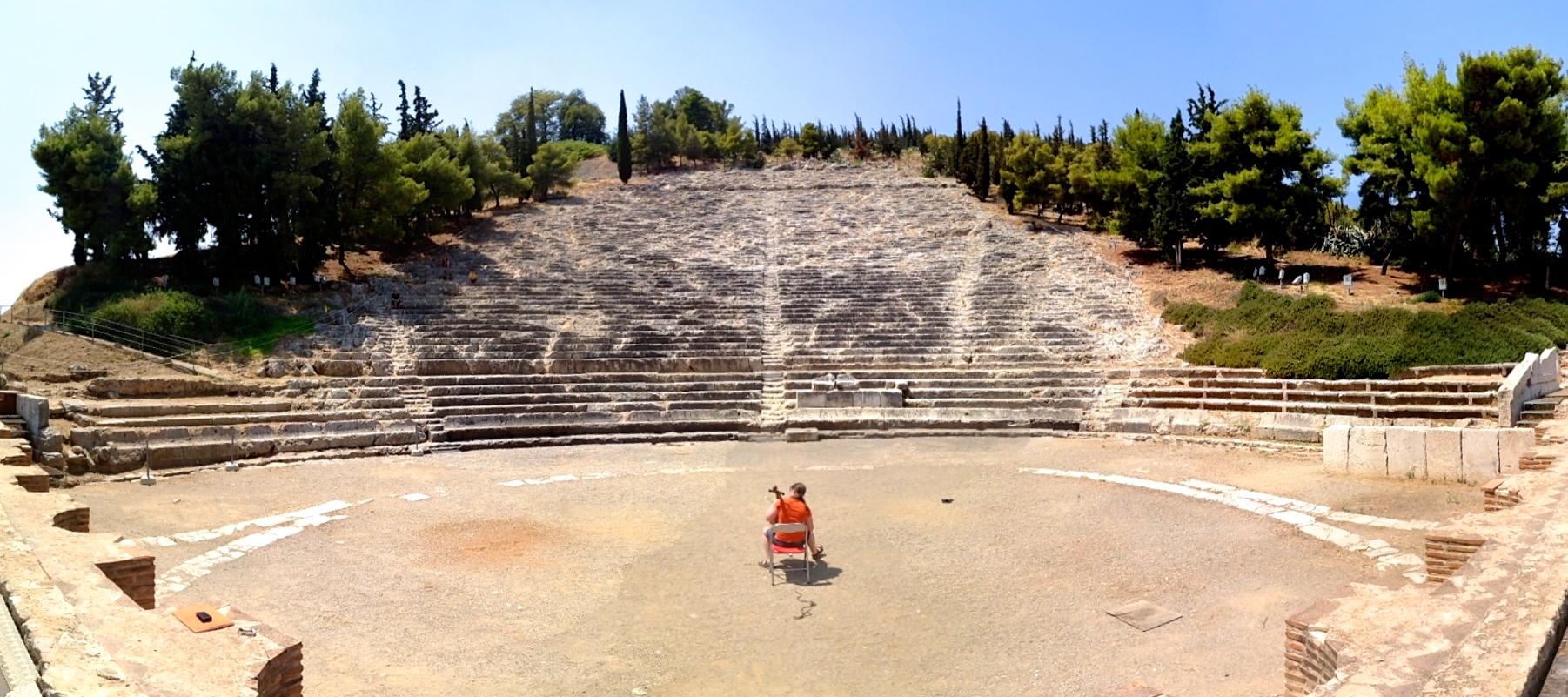
A few years ago, Amira and I, along with our good friend Kostas, were driving all over the Peloponnese doing cool stuff, and we decided to check out the Theater of Argos.
In reality, it's a big, ancient Roman theater built on top of a smaller, but even more ancient Greek one, which dates back about 2,300 years.
These ancient theaters are famous for their acoustics. If you stand in the right spot, you can whisper and everyone in the stands can hear you.
What blew our minds was that when we arrived, there was a German girl sitting on a chair in the acoustic hot-spot playing the cello.
She was very good. And it sounded amazing.
Get our free email newsletter! (It takes 3 seconds to subscribe!)
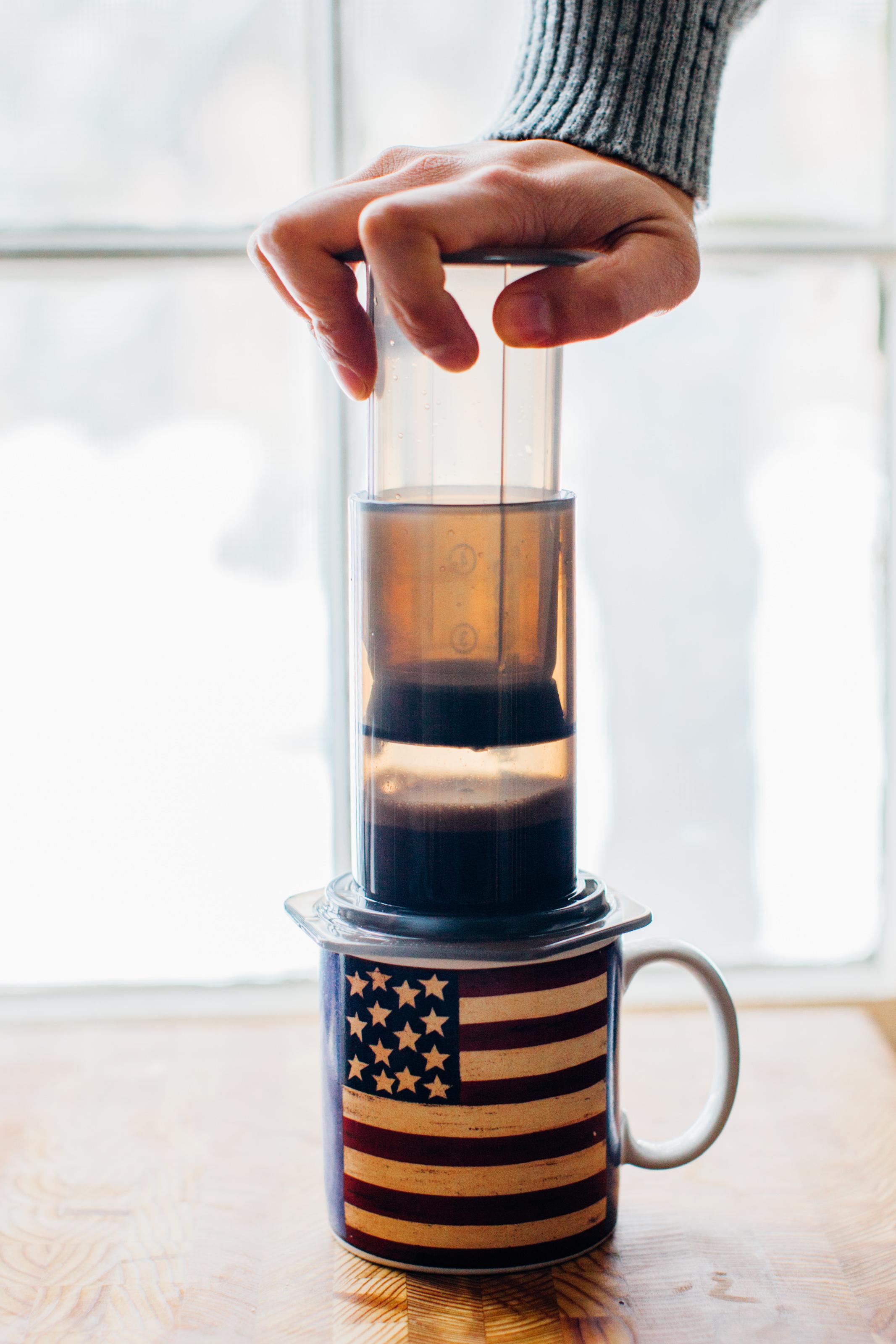
I'm obsessed with good coffee. And I've collected coffee making devices from all over the world. I've written about a few of them here.
For example, remember when I told you about my vietnamese coffee maker?
And my ugly Italian Bialetti coffee maker?
Or my beautiful one?
Or my obsession with making Turkish coffee?
I love them all. But the truth is that all these are packed away and stored in boxes. The coffee maker I actually travel with and use everyday is my Aerobie AeroPress coffee maker.
Here's why:
* It's light and compact, and so it's compatible with packing light for travel
* It's easy to use: When I'm done, I just pop the coffee and filter into the trash and rinse
* It's cheap: The coffee maker itself is very inexpensive, and it doesn't need a lot of coffee to brew a strong cup
* It's flexible. I buy coffee in random stores all over the world. Some of it is powder-fine. Sometimes I buy beans and crush them with a mortar-and-pestle. The AeroPress handles it all.
I love my AeroPress.
Here's all the stuff I use and recommend.
#coffee #aeropress
Get our free email newsletter! (It takes 3 seconds to subscribe!)